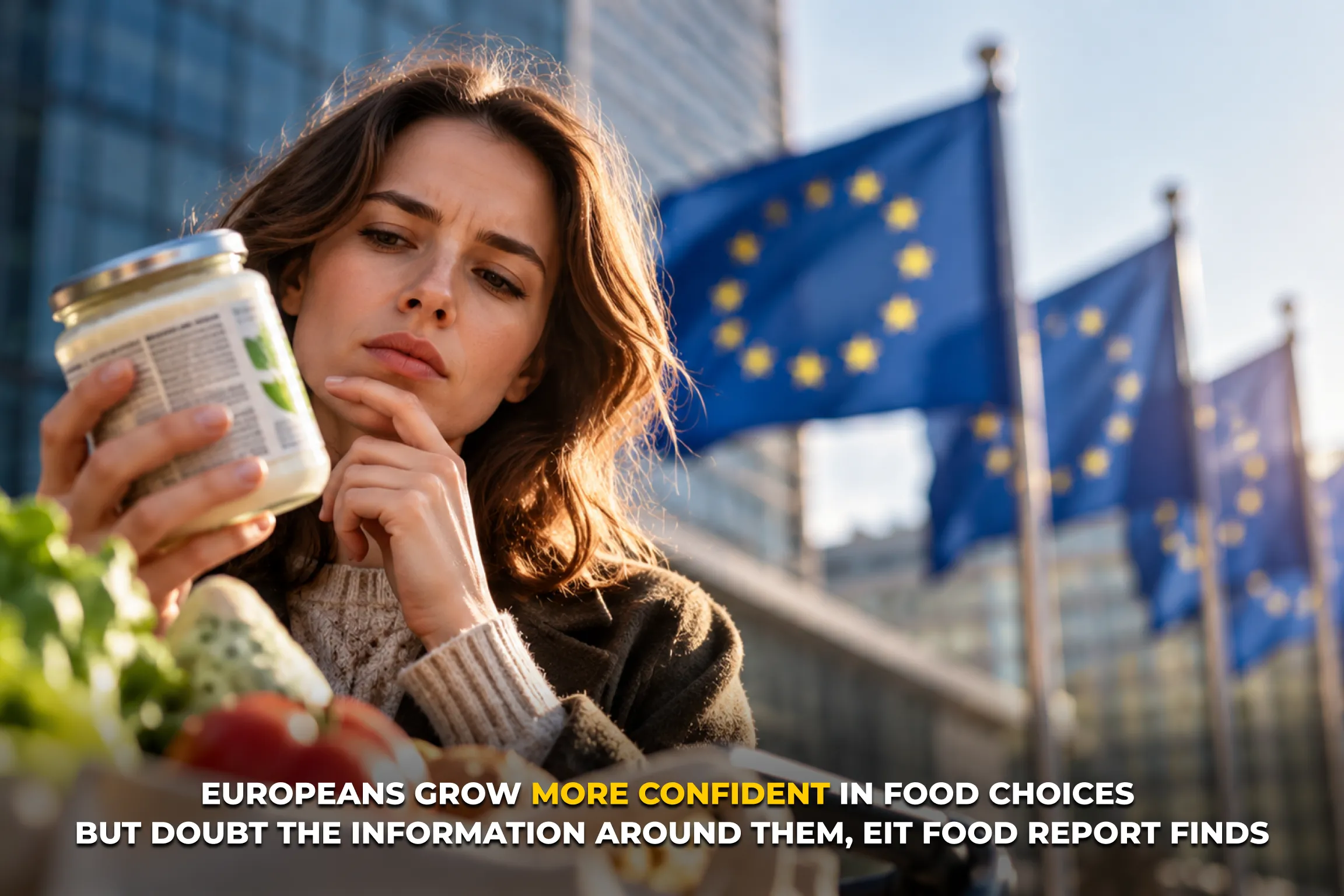
The share of consumers who feel able to make good choices has risen to 66%, yet fewer than half consider food information reliable — with the most doubt over sustainability.
A new report from the EIT Food Consumer Observatory — an initiative of the European Institute of Innovation and Technology (EIT) — published today (28 September 2026) to mark the International Day for Universal Access to Information, shows European consumers growing more confident in their food choices despite scepticism about the information available to them, FoodBev Media reports.
Europeans have more food information at their fingertips than ever, the report says, but deciding whom and what to believe remains hard. Titled «Who do consumers believe?» and co-funded by the European Union, it draws on responses from around 20,000 consumers in 18 European countries, exploring how they feel about their own food choices, what they think they know about healthy and sustainable diets, how well they can spot reliable information, and which sources they trust.
Confidence in choices rises, trust in information does not
The findings point to a widening gap between consumers’ confidence in their own choices and in the information available. The share of Europeans who feel able to make good food choices rose from 60% in 2024 to 66% in 2025, yet fewer than half consider food information reliable. 53% say they know where to find sources they trust, suggesting some confidence in being able to identify reliable sources.
Health versus sustainability
Respondents felt more at ease navigating health than sustainability. Nearly three-quarters (72%) say their knowledge of healthy diets is sufficient and 62% say they can judge how healthy a food is; for sustainability, those figures fall to 52% and 47%.
Age and trust
Confidence varies by age. Consumers aged 55 and over are the most confident, with 70% feeling positive about their choices versus 62% of under-35s — yet fewer than half of those 55+ feel sufficiently knowledgeable about food sustainability.
Among low-trust consumers, only 37% feel able to judge the sustainability of food, against 65% among higher-trust consumers, suggesting access to information alone may not be enough if trust in the source is low.
Who is trusted — and who is not
Farmers were identified as the most trusted actors across the food chain overall (the publication cites trust figures of 49% in 2024 and 64% in 2025).
Trust in manufacturers slipped from 41% to 39%, and fewer than one-third of consumers consider retailers, public authorities, restaurants and caterers reliable sources of food guidance.
Doctors, health practitioners, scientists and academics enjoy more confidence, but trust in them is also declining; traditional and online media face greater scepticism, and online influencers rank among the least trusted sources.
Klaus G. Grunert, professor of marketing at Aarhus University and lead of the EIT Food Consumer Observatory, said:
«Consumers do not appear to be asking simply for more information. They need information they can understand, assess and trust».
He added that confidence in one’s own choices can grow even while confidence in the information environment stays fragile, and that closing these gaps will take clearer, evidence-based and coordinated communication on food — particularly on sustainability, where consumers report the greatest uncertainty.
Source: FoodBev Media