
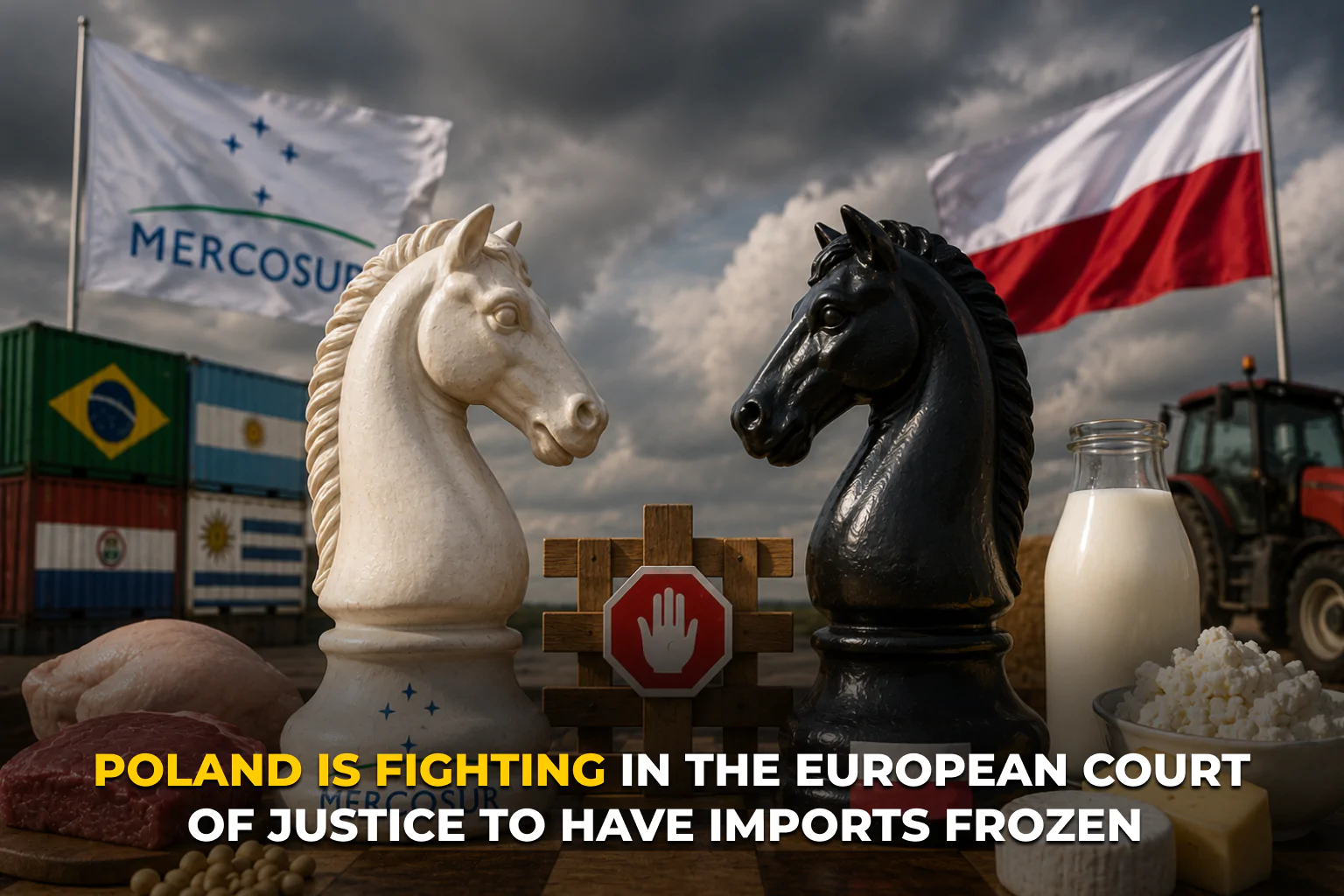
Milk and dairy products have become the focus of the most heated dispute between Warsaw and Brussels. According to agroprofil.pl, the Polish dairy sector, faces an unprecedented threat linked to the entry into force of the trade agreement with the Mercosur countries. The Polish government, responding to the concerns of producers, has officially referred the dispute over Polish milk to the Court of Justice of the European Union, demanding an immediate ban on imports from South America.
Milk at the centre of the dispute: Poland lodges a complaint with the European Court of Justice
Deputy Prime Minister and leader of the Polish People’s Party (PSL), Władysław Kosiniak-Kamysz, stated unequivocally: ‘We stand by our word!’ The Council of Ministers has officially approved the motion to refer the Mercosur agreement to the Court of Justice of the European Union. This is not merely a political manifesto, but a genuine fight for the milk, beef and poultry produced on Polish farms.
According to Katarzyna Szymańska-Borginon, our Brussels correspondent, speaking on RMF FM, the Polish complaint will include a so-called interim measure. This is the strongest legal instrument available. If the court upholds it, the application of the agreement will be suspended (frozen) until a final ruling is issued. Given that the average waiting time for a ruling from the Court of Justice of the European Union is 20 months, such a step is necessary to protect the market from a collapse in prices.
Has cheap milk bypassed parliaments?
Controversy surrounds not only the content of the agreement with the Mercosur countries (Brazil, Argentina, Paraguay and Uruguay), but also, more importantly, the way in which the European Commission has pursued these provisions. Brussels employed a cunning tactic: it split the agreement into two parts:
1. The trade component directly affects Polish milk by reducing tariffs within quota limits. It came into force on 1 May 2026 without the need for consultation with national parliaments.
2. A partnership agreement that requires full ratification by the member states.
Poland, together with the European Parliament, is challenging the legality of this division. Poland has until 10 July to formally join the proceedings before the European Court of Justice. The involvement of Polish MEPs, notably Krzysztof Hetman, demonstrates that protecting the agricultural sector is currently a priority that transcends political differences.
An uneven battle: EU standards versus the reality in South America
Why is the EU with Mercosur agreement causing such concern among dairy producers? The answer is simple: production costs. Polish milk is produced in accordance with strict environmental, animal welfare and hygiene standards. Our farmers invest millions in meeting EU requirements, whilst farmers in Brazil and Argentina use cheaper feed, plant protection products and medicines that have long been banned in Europe.
From 1 May, the EU market may be affected by:
- Milk and dairy products at significantly lower customs duties,
- Beef and poultry in huge quantities,
- Sugar and ethanol.
What next?
Poland is currently the only country to have taken such a bold independent step. Although France, Ireland, Hungary and Austria have also opposed the agreement, Warsaw has taken the most concrete legal action.
If the agreement can be put on hold, Polish milk will receive much-needed protection. Otherwise, purchase prices for agricultural products could react very sharply to new supplies from South America.
Source: agroprofil.pl