
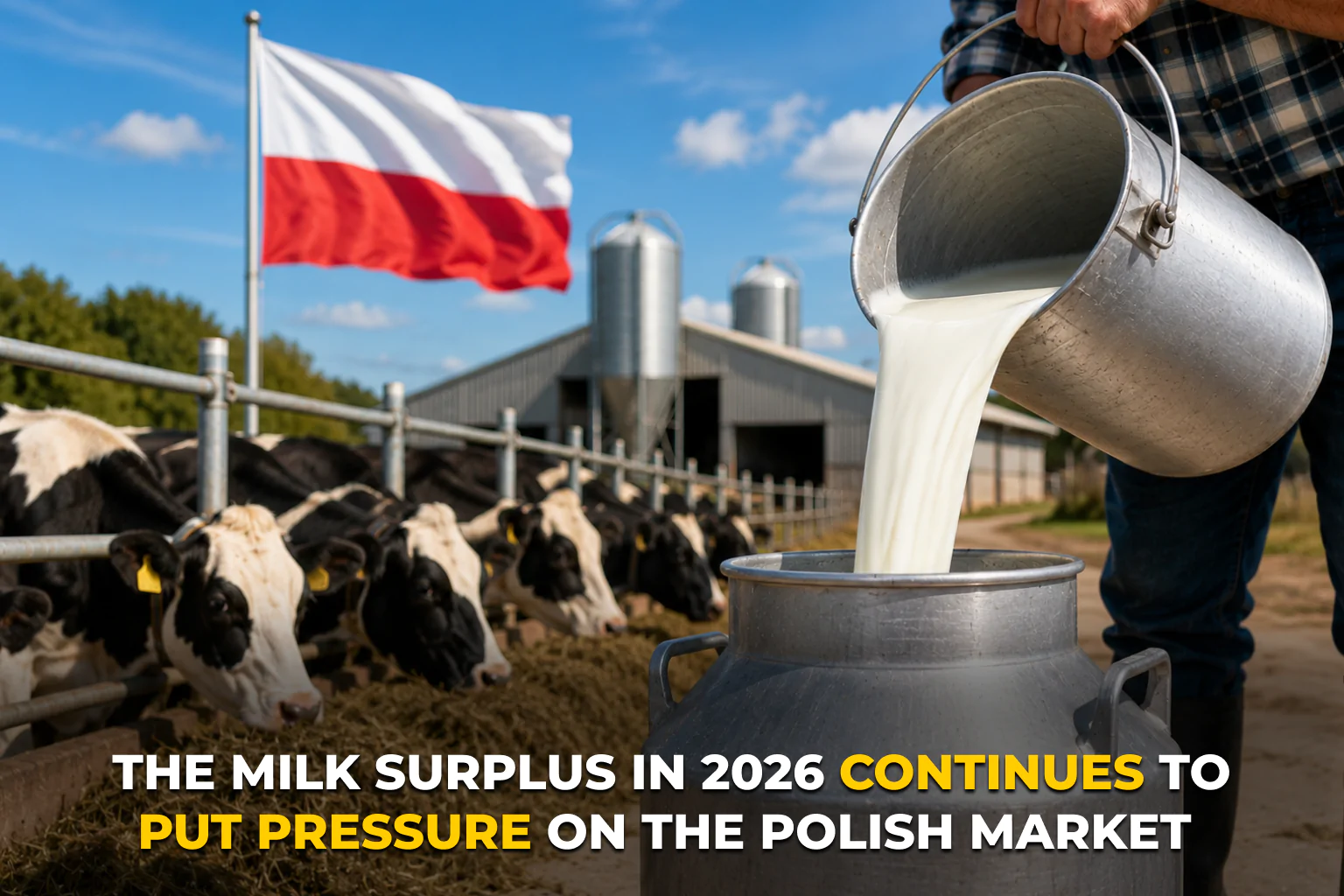
The start of 2026 saw some recovery in the global dairy market following a series of sharp declines in the second half of 2025. However, prices for dairy products remain significantly lower than a year ago, as noted by FXMAG.
A series of price rises on the GDT exchange
The series of sharp falls that began in the second half of 2025 is continuing. Nevertheless, prices for dairy products are currently significantly lower than they were during the same period last year.
The sharpest fall in prices has been seen for butter (-42.8% year-on-year) and whole milk powder (-29.0% year-on-year). To a lesser extent, prices have also fallen for cheese (by an average of around -20.9%) and skimmed milk powder (-18.0% year-on-year).
As a result, the price ratio between milk fat and protein has fallen significantly.
The latest Global Dairy Trade (GDT) auctions in New Zealand have sent a clear signal to the market. Since the start of the month, prices have risen by a total of 19.2% across five consecutive auctions.
The GDT exchange is traditionally regarded as one of the key indicators of the global dairy market, particularly with regard to milk powder, and its performance is therefore seen as an important signal for global price trends.
The milk surplus is set to continue at least until the second quarter
Despite a certain improvement in market sentiment, milk production volumes among the world’s largest exporters continue to rise rapidly.
In the fourth quarter, milk deliveries rose by 4.2% year-on-year, following a 3.2% increase in the third quarter. This represents the highest growth rate since 2021.
The increase in production is a global phenomenon and is being observed in most key regions:
- EU;
- USA;
- New Zealand;
- Argentina.
Only Australia is seeing a decline in milk production.
The increase in shipments was particularly noticeable in EU countries, where production had generally been on a downward trend in recent years — particularly in Germany, France and the Netherlands.
Why is Europe ramping up production again?
One of the main factors behind the growth in production in Europe was the favourable weather conditions in 2025.
The absence of severe heat stress for the livestock and the availability of large quantities of relatively cheap feed have enabled farmers to increase milk yields.
At the same time, even though there has been a slight upturn in demand for dairy products, the market is unable to absorb the additional volumes of milk.
The strong euro against the US dollar is also creating additional pressure. The high EUR/USD exchange rate is undermining the competitiveness of European exports on global markets and increasing the milk surplus within the EU.
The pace at which the surplus is falling is the main risk factor
Analysts at FXMAG believe that dairy prices have probably already bottomed out.
However, for the market to recover steadily, there needs to be a gradual reduction in the surplus supply of milk.
According to the publication’s estimates, the high rate of production growth is likely to continue until at least the second quarter of 2026.
In the second half of the year, agro-meteorological conditions in the Northern Hemisphere will be a key factor. If the weather returns to its long-term average, this could limit milk production and gradually reduce the supply surplus.
Forecast for Poland
If this scenario were to materialise, prices for dairy products could start to rise as early as the end of the third quarter of 2026.
FXMAG forecasts that milk purchase prices in Poland could reach:
- around 210 zlotys per head by the end of 2026;
- around 230 zlotys per hectare by the end of 2027.
The main risks to the forecast remain:
- weather conditions in key markets;
- the rate at which the surplus milk supply is being reduced;
- the pace at which producers are adapting to lower prices.
Source: FXMAG