
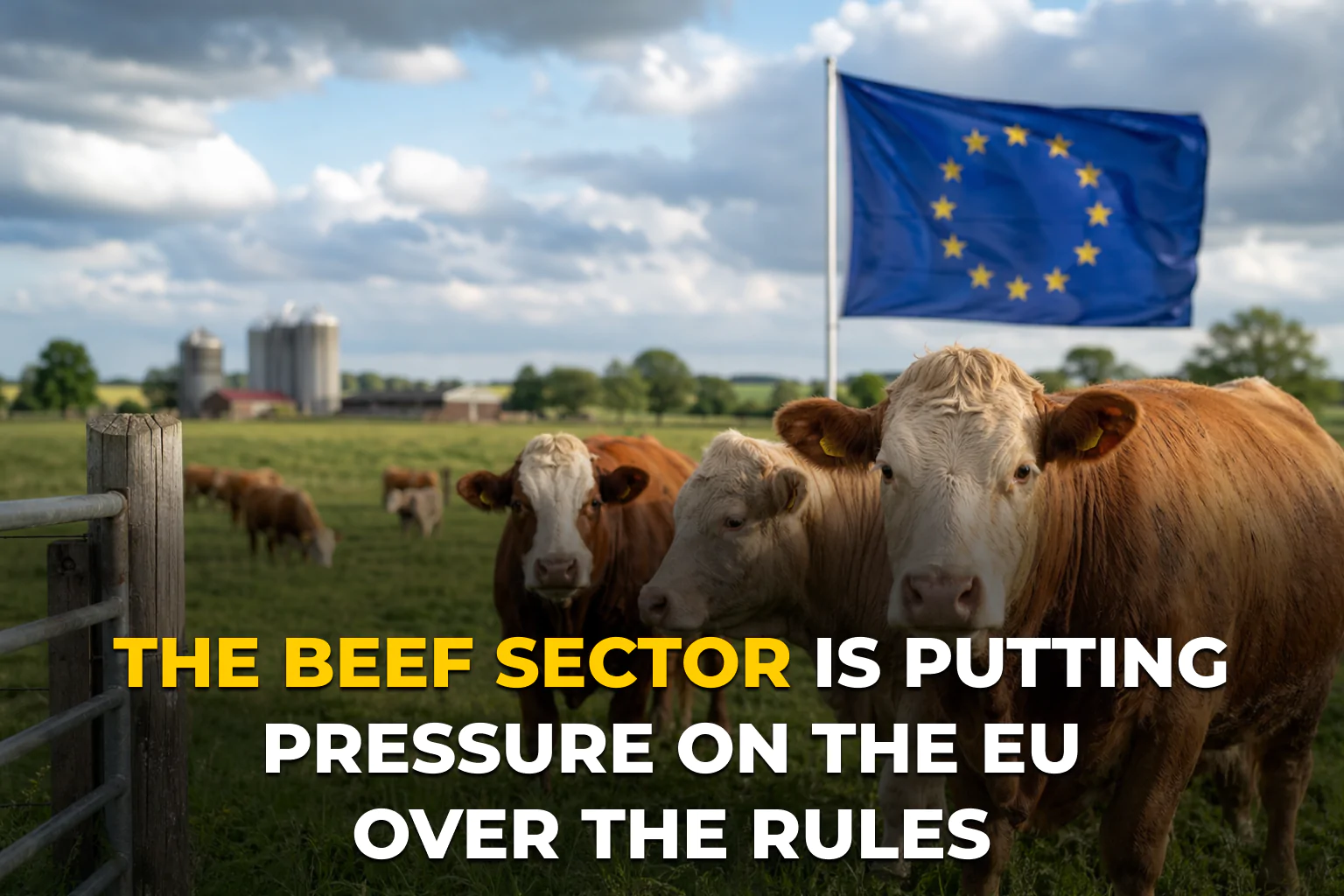
The European beef sector is calling for a review of outdated support mechanisms and their adaptation to market conditions. According to Topagrar.pl, the key issue is reference prices, which no longer reflect reality.
During the meeting of the Copa-Cogeca ‘Beef’ Working Group, one of the most discussed topics was the reference prices for beef. Participants acknowledged that these prices were outdated and did not reflect market realities.
It is precisely this issue that best illustrates the wider problem currently facing the sector: EU support measures for the livestock sector are failing to keep pace with changes in production, trade and stockholding costs. As a result, the sector is calling not for cosmetic changes, but for a more fundamental review of the rules.
However, the working group’s meeting covered much more than just a discussion of prices. The discussion also focused on the future of the EU’s livestock farming strategy, the role of agriculture in the new European Competitiveness Fund, and the direction of change in the Common Agricultural Policy.
A strategy for livestock farming: less oversimplification, more balance
Copa-Cogeca is preparing a response to the European Commission’s consultation on the EU Livestock Strategy. Agricultural organisations want the future strategy to strengthen the sector’s competitiveness rather than restrict it.
In their view, livestock farming should be regarded as a key component of food security, the rural economy and the EU’s food system as a whole. This approach was also highlighted in the speech by Jerzy Wierzbicki, President of the Polish Association of Beef Cattle Producers, who was representing the Federation of Sectoral Unions of Agricultural Producers:
— I would like to emphasise that in many EU documents — for example, in the European Strategy for Combating Cancer — meat is sometimes stigmatised as a carcinogenic product, and its consumption is portrayed as being just as harmful as smoking. The fact that meat plays an important role in a balanced diet and is essential for many people is being ignored, he noted.
As he added, it is not possible to use a single, simple message for all consumers.
“Calls for everyone to reduce their meat consumption can be dangerous, for example, for pregnant women or growing children. This does not mean encouraging excessive consumption, as even too much water can be harmful — these issues need to be balanced,” said Jerzy Wierzbicki.
This is an important signal, as the debate on the future of livestock farming is increasingly moving beyond the realm of production to encompass health, nutrition and climate policy. According to the participants, this is precisely why the future strategy must not be based on oversimplifications.
Livestock farming in a closed-loop economy
Another important topic was also clearly highlighted during the discussion: the role of livestock farming in a closed-loop economy. Participants emphasised that livestock production is important not only for food security but also for the nutrient cycle.
Natural fertilisation associated with livestock farming helps to reduce the use of mineral fertilisers. The development of biogas plants and distributed energy systems enhances the economic and energy resilience of rural areas. For the sector, this is an argument that livestock farming should not be viewed solely through the prism of emissions and restrictions. Copa-Cogeca emphasises that the sector can be part of the solution, not just the problem.
At the same time, the organisation is calling for a move away from a ‘one-size-fits-all’ approach. In its view, excessive regulatory burdens are holding back investment, hampering the modernisation of farms and undermining the competitiveness of production in the EU.
European Competitiveness Fund: agriculture as a strategic sector
The second major topic of discussion was the concept of the European Competitiveness Fund. Copa-Cogeca insists that agriculture be clearly defined as a strategic sector requiring dedicated funding.
The organisation notes that the current instruments of the Common Agricultural Policy do not meet growing investment needs. This relates, in particular, to infrastructure, digitalisation, innovation and the introduction of new technologies for sustainable development.
In practice, this means that the European Competitiveness Fund should not replace funding under the SAP, but should complement it. It is also important to simplify access to funding for farmers and cooperatives.
Copa-Cogeca also stresses the need for minimum financial quotas for agriculture, otherwise the sector risks losing out to large industrial sectors in the competition for resources. Among the priorities are investments in climate resilience, animal health, food security and reducing dependence on imports of key resources.
Jerzy Wierzbicki pointed out that the EU’s strategic reserves should be funded from a separate source, rather than from the SAP budget.
“The EU’s strategic reserves should be funded from this source specifically, rather than from the SAP funds, as this is a matter of security policy, not agricultural policy,” he said.
At the same time, he noted that the management of stocks should remain within the remit of DG AGRI, so that their rotation does not disrupt the markets.
The State Anti-Monopoly Service and the beef market: current mechanisms are outdated
The most concrete and practical conclusion of the meeting concerned the Common Agricultural Policy and the beef market. On this point, the participants were unanimous: the current decisions need to be changed.
First and foremost, reference prices were highlighted. According to the working group’s assessment, these are outdated and do not reflect the market situation; consequently, they no longer fulfil their function as a benchmark for support mechanisms.
Another issue is intervention purchases. Participants described the current model as outdated and unsuited to modern conditions. The proposal involves a shift from purchasing quarters of carcasses to purchasing individual cuts, which better reflects the realities of production and trade, as well as simplifying stock rotation and reducing storage costs.
It was this part of the discussion that was particularly important for beef producers, as it shows that the sector is not looking for general statements, but for specific tools that will work in practice.
Conclusions: The EU needs to strike a better balance between its objectives
The meeting of the ‘Beef’ working group revealed that the sector expects the EU to adopt a more realistic approach to livestock farming and the meat market. This involves both a strategy that does not stigmatise animal products and financial and market instruments that will genuinely help farms to invest and remain competitive.
The common conclusion is clear: future EU policy must better balance environmental, health and economic objectives. The beef sector wants the EU to recognise its importance for food security, rural development and the sustainability of the entire food system.
The most pressing conclusion? The reference prices for beef must finally be brought into line with reality.
Source: Topagrar.pl