
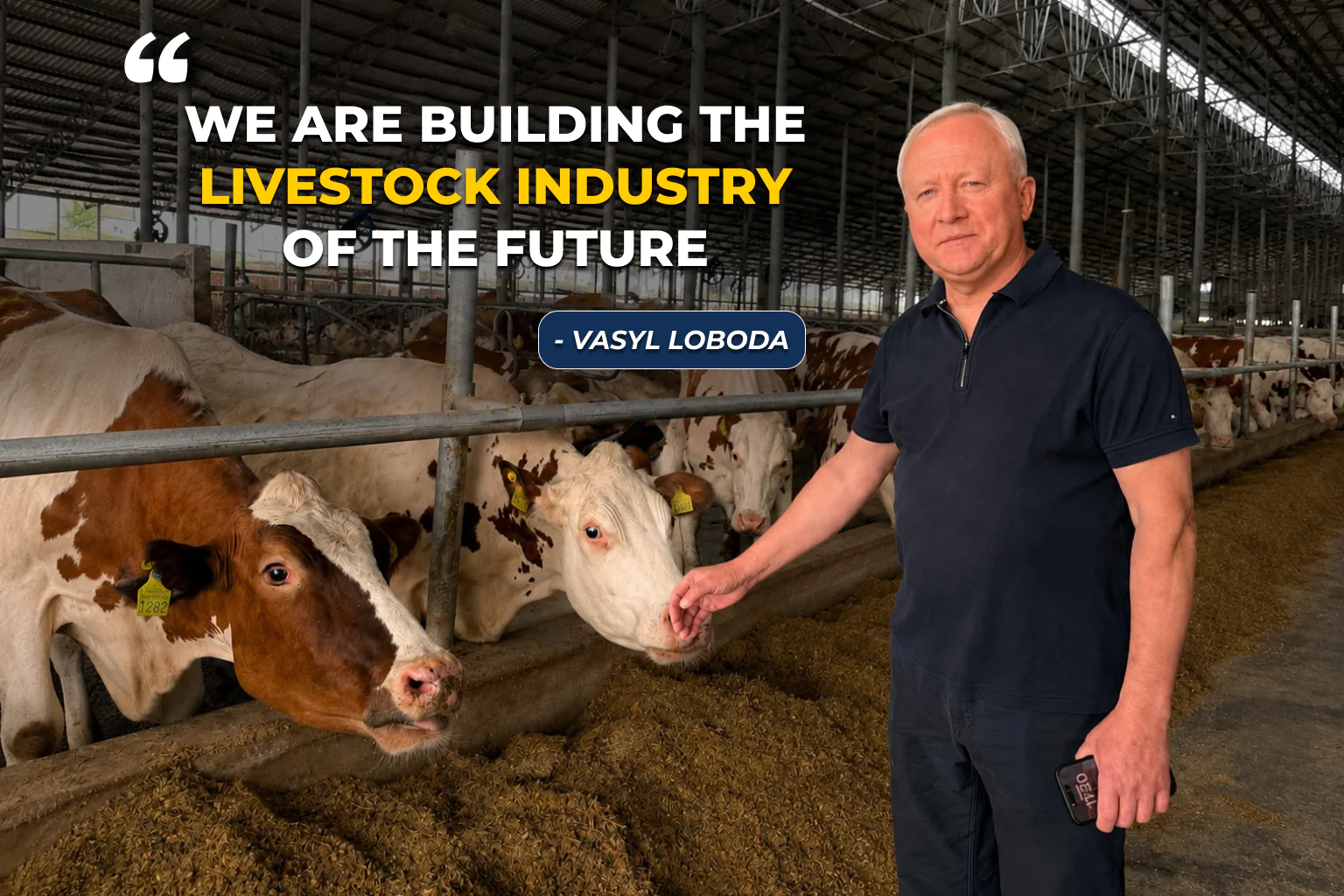
The group of companies Inter Agricultural LLC and AC Nyva-Plus LLC continues a large-scale modernisation of its livestock operations, investing in cutting-edge technologies, automation, and employee comfort. In an interview with “Ichnyanshchyna Agrarna,” Deputy General Director for Livestock Farming Vasyl Loboda spoke about record milk yields, “smart” farms, electric vehicles, organic fertilisers, and the company’s future development plans.
Vasyl Loboda describes the results for 2025 as a ‘technological breakthrough’. The enterprises have managed to significantly boost productivity and reach the level of Ukraine’s leading farms.
“We have significantly increased milk yield per cow by 2 tonnes 600 kilograms. As a result, we have reached a level of 11.6 tonnes per cow. This has enabled us to take one of the leading positions among Ukraine’s top farms. In total, we produced over 15,000 tonnes of milk, which is 3,000 tonnes more than the previous year. This is a significant achievement for the management and our entire team,” emphasises Vasyl Loboda.
One of the key areas of development has been the modernisation of livestock housing and the transition to modern livestock management practices.
Last year, the company commissioned a state-of-the-art barn for 400 cows and a DeLaval milking parlour for 48 cows. Nyva-Plus is currently developing a ten-row barn for 1,044 cows, featuring soft rubber mats, automatic ventilation and mechanical massage brushes.
- Comfort for cows: Nyva-Plus is currently fitting out a ten-row barn with capacity for 1,044 cows. The barn is equipped with soft rubber mats for the animals to rest on, mechanical massage brushes and an automatic ventilation system.
- Process automation: the feed table is filled by powerful mixers and turned over by robots; manure removal is also mechanised.
“We are moving away from tethered housing. I hope that we will soon be able to move out of the old premises entirely and into the most comfortable possible parlours for both the milking herd and the dry cows. These are state-of-the-art global standards,” says Vasyl Petrovych.
The company places particular emphasis on energy efficiency and green technologies.
Another difficult autumn and winter, marked by a significant electricity shortage and rising costs, has forced business owners to seek alternative sources of supply. The livestock sector is now switching to ‘green’ technologies. For example, the company’s specialists are switching to modern electric vehicles.
“We’ve bought four electric cars. The group of companies has installed a solar system—panels—so we have an alternative energy source. This means zero refuelling costs. Life is forcing us to move away from expensive petrol and diesel. I think this approach will eventually be extended to heavy machinery and staff transport,” says Vasyl Loboda.
Another area of development is the production of organic fertilisers. The company has purchased an Austrian aerator that enables farm waste to be converted into organic fertiliser.
‘We have already processed our organic matter through aeration and fermentation. The first 6,000 tonnes of this fertiliser were used on maize crops. Overall, we plan to produce up to 50,000 tonnes of organic matter per year. The cost and European requirements for mineral fertilisers will force businesses to move further away from chemical fertilisers, improving soil structure using their own resources. The shareholders’ plans include the construction of a biogas plant,” says Vasyl Loboda.
The company sells only top-quality milk and relies not only on technology but also on its staff.
Vasyl Loboda is convinced that technology is an important tool, but what matters most are the people. Today, the group’s livestock sector employs 136 staff members.
“We sell only top-quality milk. This is also down to our female milkers. They are very responsible, strictly adhere to the rules and procedures, and maintain impeccable hygiene. And this is rewarded: a milker’s average salary is 30–35 thousand hryvnias. We are building staff accommodation with kitchens and all the necessary amenities. At ‘Nyva-Plus’, a 25-bed hotel has been opened. At ‘Inter’, a 20-bed hotel is currently under construction. Our shareholders assist with the purchase of housing. If a person wants to work, we will create all the necessary conditions for them,” emphasises Loboda.
Home-grown feed and balanced diets play a key role in productivity.
Vasyl Petrovych is convinced that a cow’s health and the quality of its milk start at the feeding trough. We are deeply grateful to our colleagues – Vladyslav Anatoliyovych Tyutyunnyk, Deputy Director General for Crop Production, for the high-quality forage crops, and Chief Engineer Volodymyr Oleksandrovych Palinchak for the efficient harvesting.
“Of course, as productivity increases, milk yields need to be supported. We add premixes containing minerals and vitamins to the feed rations. But the foundation is our own production. We produce our own compound feed: we use barley, maize, wheat – everything that is grown on our fields. We only buy protein supplements from the market,” says the Deputy General Director for Livestock.
The company is also actively working on genetics and herd selection.
The company ‘Nyva-Plus’ has the status of a breeding stock producer, whilst ‘Inter’ is in the process of registration.
‘We are improving our herd in two main areas: Red-and-White Holsteins and Montbéliards. We haven’t changed our breed selection, but we are constantly raising standards. Genetics pass on their traits to the next generation, and with each cycle we raise the bar for productivity. Our specialists are constantly learning – recently, four of them travelled to Ternopil to the ‘Agroprodservice’ farm for training to master European standards of livestock farming. A high-yielding cow requires deeper knowledge,” says Vasyl Petrovych Loboda.
“The team of specialists at ‘Inter’ and ‘Nyva-Plus’ is exceptionally strong in all aspects of managing and monitoring developments in the livestock sector, covering both animal husbandry and veterinary science. This is a team that is driving technological innovation and has secured a leading position in the Ukrainian livestock industry,” says Vasyl Loboda.
Five-year strategy: ‘carousel’ and in-house processing
Looking to the future, Vasyl Petrovych Loboda envisages even more significant growth. His vision is one of independence and scalability.
- Expanding the herd: this year’s goal is to exceed the target of 12,500 kilograms of milk per lactating cow. In the near future, the aim is to increase the total cattle herd at ‘Nyva-Plus’ to 7,500 head.
- Technology: construction of another state-of-the-art milking parlour – a 72-cow ‘carousel’ with two robots.
- Independence: ‘I envisage us having our own processing facilities so that we are not at the mercy of processing plants when it comes to pricing.’
- Meat production: the development of a large-scale facility at ‘Inter’, specifically to house 800 bull calves for rearing into market-ready stock as early as this year.
“Our shareholders see investing in livestock farming not just as a business, but also as having a significant social dimension,” notes Vasyl Loboda. “Farms that fail to modernise have no future. We, on the other hand, are constantly learning, seeking out best practices and improving our skills. Our livestock sector is a fully-fledged, modern industry that competes confidently with crop farming. Shareholders invest in the development of businesses and people, whilst management ensures the high standards of the livestock sector.”
‘This is what a modern Ukrainian village looks like – where responsible investors, top-class managers, cutting-edge technology and staff dedicated to their work take care of the crops, livestock, working conditions and the environment.’