
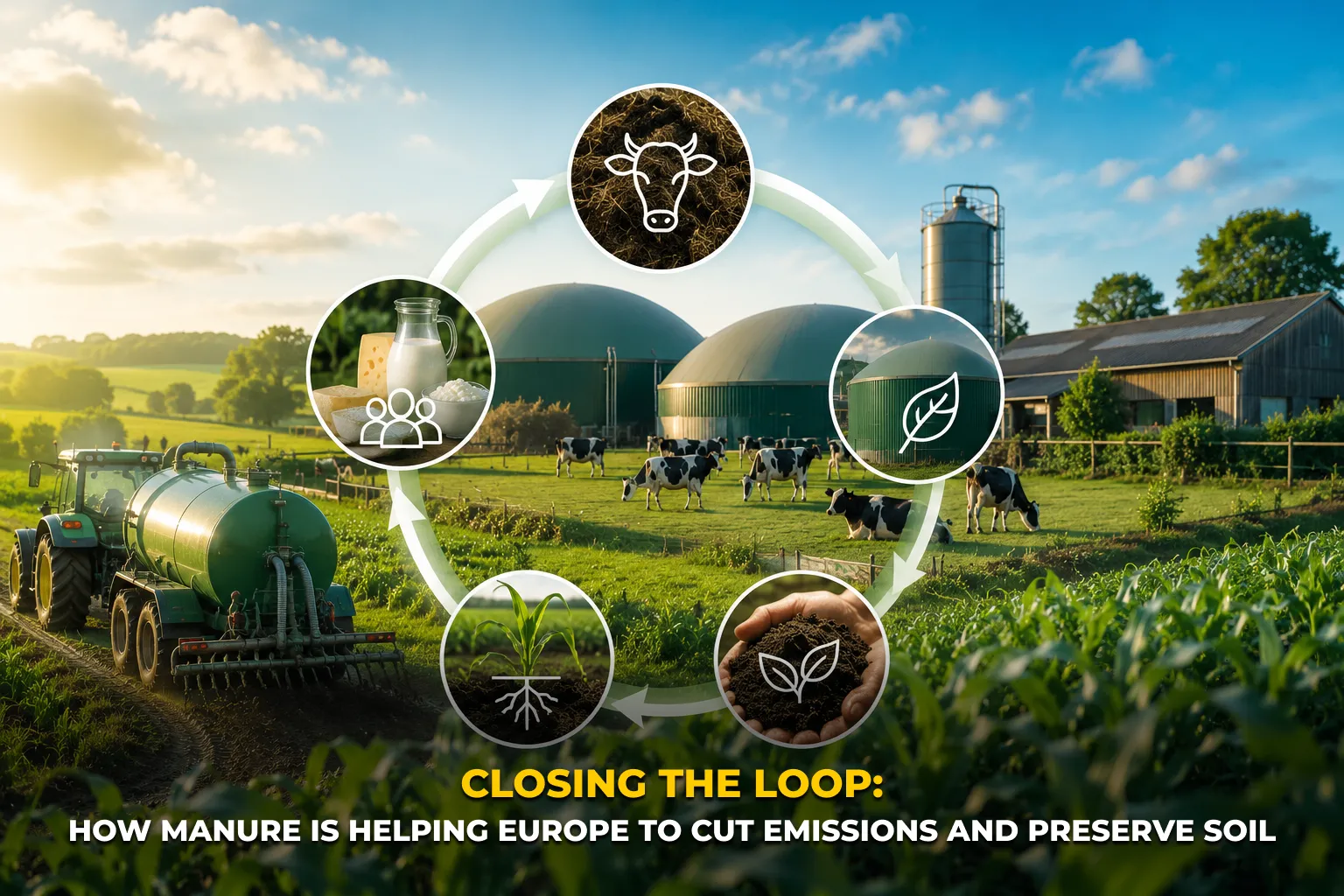
As the EU works to strengthen the resilience, competitiveness and sustainability of its livestock sector, recovering nutrients already available within Europe is becoming increasingly important: rather than a waste stream, manure can be a valuable resource for bio-based fertilisers, cutting emissions and supporting a circular farming system, the European Commission reports. That is the challenge at the heart of FertiCovery, an EU-funded research and innovation project coordinated by BTG Biomass Technology Group (Netherlands), bringing together eight partners from seven European countries.
Rethinking manure and closing the loop
Europe already has many of the nutrients it needs, in biowaste, manure and wastewater that could be recovered and converted into bio-based fertilisers, says coordinator Martijn Vis. Manure is the largest raw-material source for bio-based fertilisers, but better use requires technologies, logistics and policies that move nutrients where they are needed — offering a way to cut Europe’s reliance on imported fertilisers. Manure, Vis argues, should no longer be seen as a waste stream but as a valuable resource that helps close nutrient and carbon cycles. Using anaerobic digestion and other recovery practices, it can become renewable energy and bio-based fertilisers that return nutrients and organic matter to soils, cutting greenhouse gas emissions and replacing part of today’s mineral fertilisers.
Solutions that already exist
FertiCovery has screened more than 150 technologies and selected 25 nutrient recovery value chains for detailed technical, environmental and market assessment, aiming to understand both performance and the barriers to wider adoption. In May 2026 it launched an online catalogue of those 25 assessments for farmers, industry and policymakers. Proven technologies with known performance, costs, environmental benefits and policy support reduce risk and speed up uptake, Vis notes. Success also depends on regulation, affordability and trust: recovered fertilisers must be practical, economically viable, legally supported and consistent enough to earn farmers’ confidence.
A more resilient livestock sector
Cutting dependence on imported fertilisers has become central amid geopolitical tensions, supply-chain disruption and rising prices. The key opportunity, Vis says, lies in building a resilient, import-independent market for bio-based fertilisers that strengthens Europe’s strategic autonomy in nutrients — an ambition mirroring the EU Livestock Strategy. Launched in January 2025, FertiCovery has completed its first 18 months and will publish assessment results in the coming months. Manure, Vis adds, offers a way to meet climate goals while strengthening resilience and competitiveness, making farming more attractive to younger generations and creating green rural jobs.
Source: European Commission