
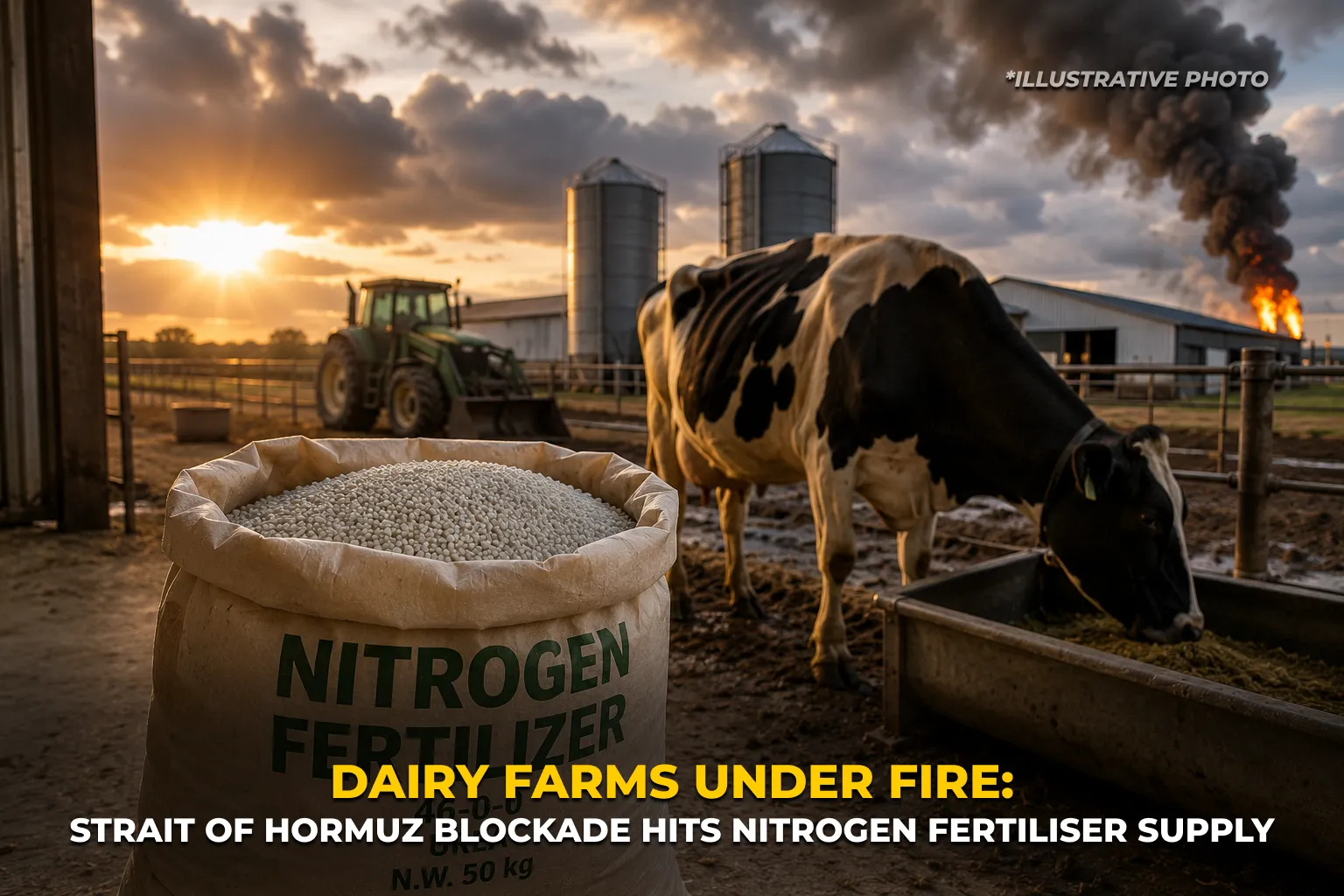
For dairy producers, nitrogen remains the most immediate concern due to its critical role in grass and silage production, as Middle East tensions threaten to keep fertiliser prices elevated and squeeze farm margins, DairyReporter reports.
Nearly five months into the conflict involving Iran, the US and its allies, the market may be moving toward a more sustained period of uncertainty. Per the International Fertilizer Association (IFA), a three-month conflict would cause only temporary disruption, with markets recovering in about 120 days; a six-to-nine-month war could need a further six to nine months to normalise, affecting input decisions and the 2027 growing season.
Nitrogen is the biggest risk
The IFA identifies urea as the finished fertiliser most exposed to disruption in the Strait of Hormuz, through which about 34% of global urea trade and roughly 23% of ammonia trade pass — along with around 20% of global LNG trade.
That link matters: some 60% to 80% of nitrogen fertiliser production costs are tied to natural gas prices, so disruption can raise costs or curb output worldwide.
European nitrogen production is especially vulnerable, the IFA says, as costs already exceed many competing regions and further gas-price rises could render some domestic capacity uneconomic, deepening import reliance.
For farmers, the risk now goes beyond delayed shipments: higher raw-material costs and logistics constraints could keep nitrogen prices high long after physical supply recovers.
Why prices could stay high
A six-month conflict could leave growers facing persistently high prices even once availability normalises, the IFA says — meaning fertiliser may be available but priced beyond viability where governments do not cushion volatility, prompting rationing that could hit the 2027 season.
Nitrogen demand should prove more resilient than other nutrients, as farmers have less scope to cut applications without harming growth: global nitrogen use could fall 1–2% under three- and six-month scenarios, but up to 4% in a 12-month conflict, with a relatively quick recovery expected if trade flows normalise by 2028.
Prolonged instability could see farmers ration nitrogen, reducing grass yields and forage quality, while even products with limited Gulf exposure face higher freight and raw-material costs.
Planning for 2027
With the conflict nearing five months, attention is shifting from immediate price and availability to future seasons: how much nitrogen to secure, whether phosphorus and potassium applications can be adjusted without compromising soil health, and how fertiliser costs compare with buying feed to replace lost grass or silage.
There is no certainty the IFA’s medium-term scenario will materialise, but the emerging risk is clear — fertiliser availability may recover faster than affordability, keeping pressure on dairy forage production costs well beyond this year.
Source: DairyReporter