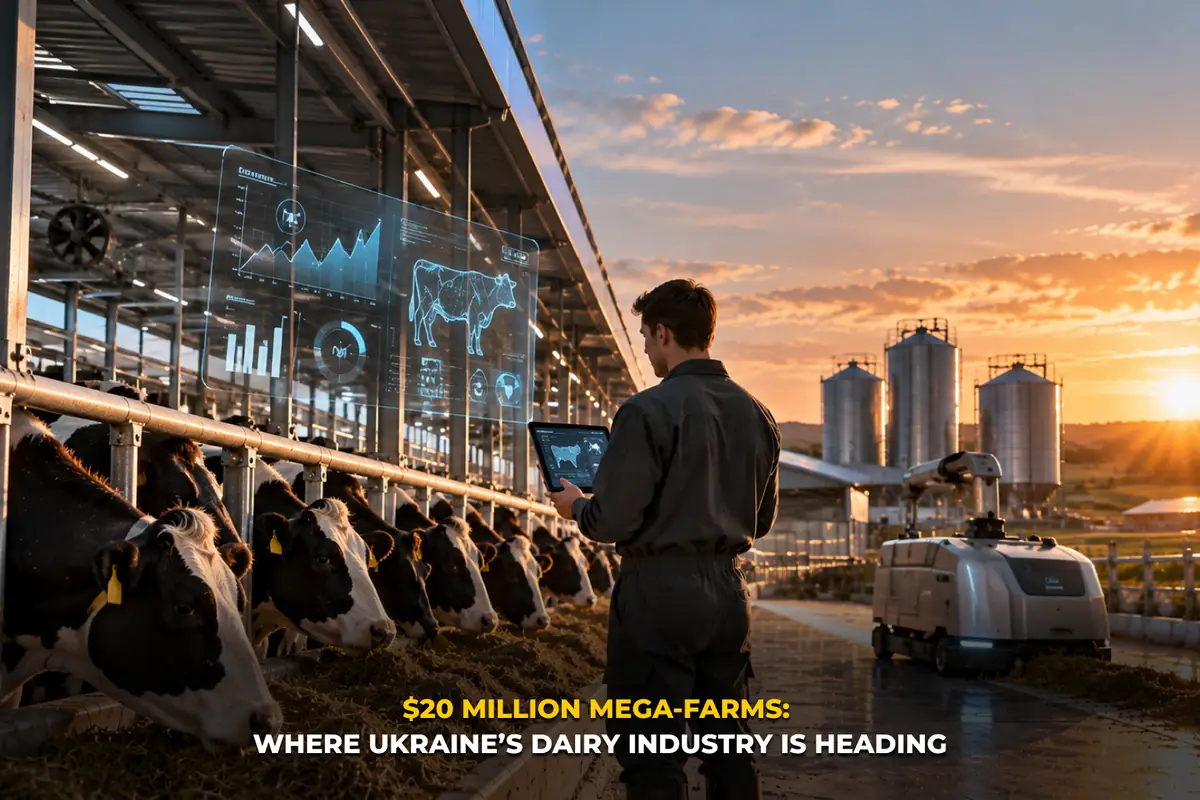
Large agricultural companies are building dairy complexes for thousands of cows, equipped with robots and artificial intelligence (AI). LIGA.net looks at how these giants will change the Ukrainian market and who will not withstand the competition.
Ukraine’s large dairy farms are expanding output even during the war. Over the past five years, industrial farms have increased production by 15%, to 3.2 million tonnes of milk a year. The fastest growth is in complexes of 2,000 cows or more, into which agricultural companies are investing tens of millions of dollars.
On these farms, robots distribute feed, automated systems manage milking and AI monitors cow health. Large farms are becoming ever more efficient, while small ones find it increasingly hard to compete.
LIGA.net examined who is building these giant dairy farms, what they cost and whether there will still be room for small producers.
Dairy, American-style
Even in wartime, Ukraine is building large dairy farms for 2,000 cows or more. To a villager with a few cows, such complexes look almost like orbital stations: robots distribute feed, milking is automated and AI systems monitor animal health.
«Our dairy industry is developing along an industrial path. It is the American model, with farms of several thousand cows, minimal costs per cow and steadily rising productivity», says Vadym Chaharovskyi, head of the Union of Dairy Enterprises of Ukraine (UDEU).
Under this model, large farms gain an advantage through scale: they can invest more in equipment, cut production costs and raise milk yields. That is why Ukrainian agricultural companies are investing not only in new complexes but also in expanding existing farms.
The 2,000+ club
One of the newest dairy complexes opened in August, when Ivan Chaikovskyi’s Agroprodservis holding launched a farm for 2,200 cows. Self-propelled robots distribute and push up feed, and CowMander systems direct cows to milking or feeding — with no person in the animal’s line of sight.
«The fewer people, the calmer the cow», says Nazarii Kmit, owner of Mukko.
Together with partners including IT entrepreneur Taras Kytsmei, he is building a large farm. Three of its five units are already operating with 1,200 cows, and the herd is set to grow to 2,000 by the end of 2026.
Ukraine’s largest dairy farm belongs to Ukrprominvest-Agro, owned by the Poroshenko family. Since 2024, the complex has housed 7,800 cows that supply the country’s largest confectionery corporation.
Ukrainian Dairy Company, owned by Vitalii Haiduk, is preparing to build a farm of comparable capacity. Plans to build large farms or expand existing dairy complexes of several thousand cows have also been announced by:
- MHP (Yurii Kosiuk);
- Eridon (Serhii Krolevets);
- TAS Agro (Serhii Tigipko);
- Ukraina 2001 (Vadym Leivi);
- Hadz Agro (OKKO Group and Petro Hadz).
None of these companies are disclosing details of their projects, citing security reasons.
However, LIGA.net found that all of these projects are designed for farms of 2,000 cows or more.
«90% of milk producers in Ukraine who have the money are already working on expanding their capacity», says Yaroslav Nitsak, CEO of GEA Ukraine, part of the German company that is a leading supplier of dairy farm equipment.
«Our calculations show that dairy farms with 1,000 cows or more generate stable profits», says Olena Zhupinas, Deputy CEO of the Association of Milk Producers (AMP).
She expects the number of farms in Ukraine to fall every year.
«It will be most painful for those with fewer than 500–600 cows», she says.
Advantage one: a better product
Large-scale dairy production cuts the cost of feed, labour and veterinary care. Industrial milk is also high quality: thanks to a continuous technological chain, industrial farms produce extra-grade milk.
Processors need that level of quality.
«Without high-quality raw milk, dairy exports are impossible», says Andrii Tabalov, owner of Voloshkove Pole.
Only milk with minimal levels of undesirable microflora — for example, no more than 100,000 bacteria per ml — qualifies as extra grade. That is out of reach even for the most meticulous household.
On industrial farms, Zhupinas explains, processes are designed so that milk stays in a controlled environment from the cow until it leaves the farm.
How the quality of Ukrainian milk has changed
Since 2015, Ukraine has been working to bring raw milk quality up to European standards. One such project is the «Dairy Module» of the Swiss-Ukrainian Quality FOOD Trade Program, involving the Research Institute of Organic Agriculture (FiBL) and SAFOSO AG.
As part of this work, a network of laboratories allows dairy farms to check raw milk quality regularly.
The result: extra-grade milk accounted for 26% of Ukrainian output in 2020 and 62% in 2025.
Advantage two: robots and AI
Robots on farms are not just about keeping cows calm — they also give dairy owners peace of mind.
«Automated systems ensure the quality of cow care. There is no option of «I forgot» or «I didn’t have time» — everything runs strictly to schedule», says Mukko’s Nazarii Kmit.
Another plus is constant AI-based health monitoring. GEA’s CattleEye system scans the cows several times a day, detecting illness three to four days earlier than regular staff checks.
A bonus is much lower veterinary costs.
«Altogether, this delivers a stable 35 litres of standard-quality milk a day», says the Mukko co-owner.
He now fully supplies his own processing operation with raw milk and, he says, sells surplus milk to Halychyna and Molokiya.
Economics that do not favour the small
The cost of a modern «orbital» farm is calculated per cow place — between $7,000 and $12,000.
Costs are highest when a manure-to-biogas plant is built alongside the farm, making it energy independent.
Almost all Ukrainian projects postpone the gas module, as happened with the Agroprodservis and Ukrprominvest-Agro farms. The reason is cost.
«By our estimates, the payback period for the gas component could stretch beyond seven years. That is why we are looking for investors for this area», says Nazarii Kmit.
Profitability depends on herd productivity. Milking cows typically make up to 80% of the herd. According to the AMP, a good benchmark is 10,000 litres of milk per cow a year, worth about $3,200.
Household cows produce half as much. Mykhailo Travetskyi, owner of Velesova Ferma, estimates their yield at 5,000 litres a year.
«But a cow kept by a smallholder lives 10 years or more. On a modern farm, they are culled after about five or six years», he says.
In his view, small dairy farms can survive in the market by processing their own milk.
«Craft production (cheeses, other products) is the only path to profit», Travetskyi says.
One example is the Mamyna Ferma cheese dairy, which processes milk from some fifty of its own cows.
Agritourism is another option for supporting small farms.
«In a few more years, city dwellers will only see cows on screens. The chance to touch a cow will be rare, so it will interest children», says Olena Zhupinas.
Competing with European producers
Meanwhile, Ukraine’s large farms are preparing to compete not only with each other but also with European producers.
According to the AMP, the average dairy farm in Poland keeps just 28 cows, and up to 50% of Polish farm income comes from EU and state subsidies.
«Large Ukrainian dairy farms receive no state support for their day-to-day operations. But even in wartime, this is a resilient business», says Olena Zhupinas.
If Ukrainian and Polish producers find themselves on equal market terms, large Ukrainian complexes will have the advantage thanks to their scale and productivity.
Source: LIGA.net