In the first half of October 2026, the positive export momentum Ukrainian dairy products showed in September did not continue. After September’s rebound, exports fell again across most product groups while imports began to rise, the official website of the Union of Dairy Enterprises of Ukraine reports.
Imports are growing particularly in certain dairy categories. October thus saw a change of direction in foreign trade: exports are shrinking while imports are mostly rising, increasing pressure on the dairy sector’s trade balance.
Overall trade dynamics
In the first half of October 2026, dairy trade under headings 0401–0406 of the Ukrainian Classification of Goods for Foreign Economic Activity (UKT ZED) totalled $27.2 million, 6.5% less than in the same period of September. Specifically:
- exports fell by 15% in value compared with the first half of September, though they remained 17% above the August level;
- imports rose by 0.5% in value compared with September and by 5% compared with August;
- the export/import ratio fell to 0.7 from 0.82 in September (0.62 in August);
- the trade balance remained negative at minus $4.8 million.
These figures suggest that September’s export improvement was a temporary rebound rather than the start of a sustained upward trend. In October, exports declined again while imports kept rising.
Exports: September’s growth did not become a trend
In September, the export situation improved markedly, with shipments of milk powder, butter and cheese recovering. By the first half of October, however, that momentum had faded: declines were recorded in almost all major product groups except cheese, where exports held steady. The sharpest falls were in:
- butter and milk fats (heading 0405) — export volumes down 50% compared with the first half of September, the deepest drop among the main product groups;
- whey (heading 0404) — down 20%, erasing part of September’s gains;
- dry and condensed milk (heading 0402) — down 10% after a notable recovery in September;
- fermented dairy products (heading 0403) — down 8%;
- drinking milk and liquid cream (heading 0401) — down 5%;
- cheese of all kinds (heading 0406) — export volumes roughly unchanged from September.
September’s export growth therefore did not hold in October. Instead of a further recovery, exports are shrinking again, most of all in butter and milk fats.
In value terms, dairy exports in the first half of October are estimated at about $11.2 million, compared with $13.1 million in the same period of September and $9.5 million in August.
Compared with September, export value fell by about 15%, returning the market to levels typical of less active months.
Imports: moving the other way
Unlike exports, dairy imports in the first half of October were mostly on the rise. While September brought mixed changes, October saw imports recover or accelerate in several product groups.
The most notable changes:
- butter and milk fats (heading 0405) — import volumes up 2.7-fold compared with the first half of September;
- whey (heading 0404) — up 15%, recovering after September’s decline;
- fermented dairy products (heading 0403) — up 5%;
- dry and condensed milk (heading 0402) — a sharp increase, roughly twofold;
- cheese of all kinds (heading 0406) — no significant change;
- drinking milk and liquid cream (heading 0401) — imports down 15%.
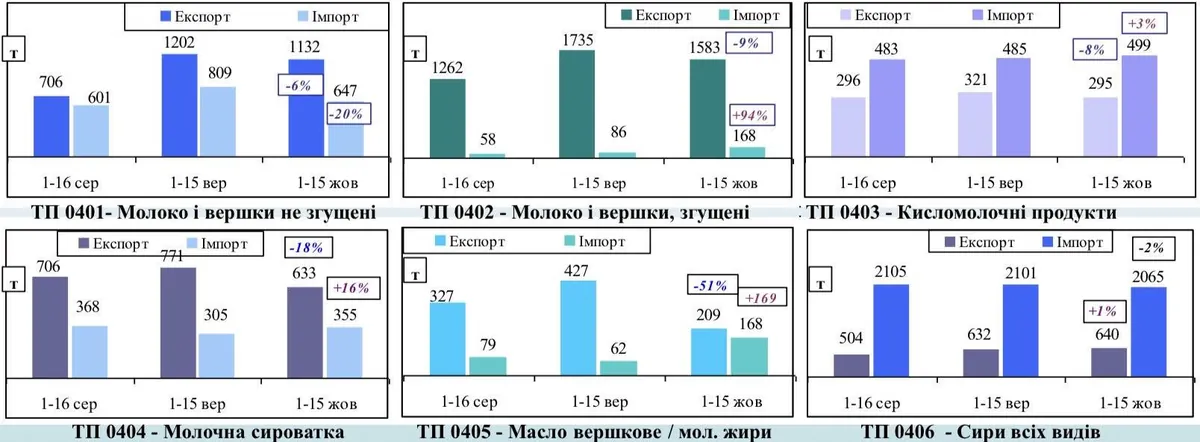
Butter and milk fats, dry and condensed milk, and whey are thus the main drivers of rising imports. Butter is especially telling: while exports of this category halved, imports rose 2.7-fold.
If import activity continues at the current pace, import value could approach the highest levels of 2026. This is, however, a preliminary estimate rather than a certain outcome, as the data cover only half of the month.
Value figures and trade balance
In the first half of September, export value rose to $13.1 million from $9.5 million in the same period of August, before falling to $11.2 million in the first half of October. Imports, by contrast, rose steadily: from $15.2 million in the first half of August to $15.9 million in September and $16.0 million in the first half of October.
The dairy trade deficit was therefore:
- August — $(-5.7) million;
- September — $(-2.8) million;
- October — $(-4.8) million.
Although the trade balance improved noticeably in September, the deficit widened again in October, reflecting two factors at once: lower export revenue and a further rise in import value.
It is important to note that the October figures cover only the first half of the month and cannot be compared directly with full-month data. Comparing like-for-like periods — the first halves of each month — nevertheless clearly shows the change in direction of exports and imports.
Conclusions
Trade data for the first half of October 2026 show that September’s recovery in Ukrainian dairy exports did not become a lasting trend. Exports fell again across most product groups, with the steepest decline in butter and milk fats. Cheese remained the exception, with shipments holding at their previous level.
October’s key change is a reversal in trade dynamics: exports are falling while imports are mostly rising. The contrast is sharpest in butter, where shrinking exports are accompanied by a multiple increase in imports.
As a result, the trade deficit widened again after narrowing in September. If the trend continues, Ukraine’s dairy sector will face even stronger competition from imports on the domestic market and a further deterioration in its trade balance.
September gave grounds to speak of an export recovery, but October showed that the growth could not be sustained. Instead, the market has returned to falling exports amid rising import activity.
Source: Union of Dairy Enterprises of Ukraine (UDEU Analytics)