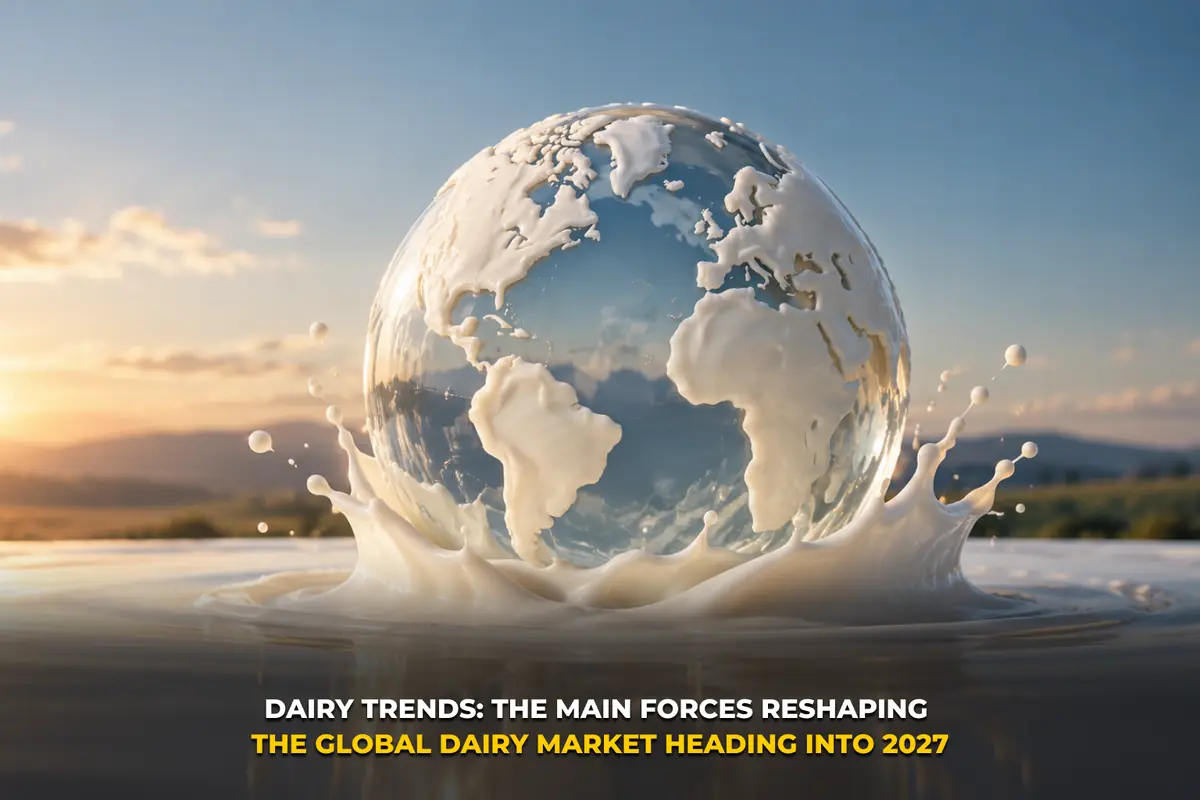
Global retail value of dairy products and alternatives is forecast to reach USD 762.1 billion in 2026, a strong 5.7% growth rate, according to market intelligence firm Euromonitor, DairyReporter reports.
Key points:
- pricing will play a bigger role than in 2025: value growth is strengthening (from 5.4% in 2025), while volume growth slows from 0.7% to 0.5%;
- coffee whitener is set to lead, with 4.1% compound annual growth to USD 12.2 billion by 2031;
- milk formula and plant-based dairy are the only categories with volume declines in 2026;
- chilled snacks (8.2%) and cheese (6.6%) are among the fastest-growing categories;
- glucagon-like peptide-1 (GLP-1) medications are redefining dairy’s wellness positioning.
Euromonitor says pricing will matter more than in 2025, as value sales growth is strengthening (versus 5.4% in 2025) while volume growth is expected to ease from 0.7% in 2025 to 0.5% in 2026.
So what are the key trends shaping dairy and alternatives on the road to 2027?
At-home coffee drives innovation
Coffee whitener is forecast to be the leading category, with a compound annual growth rate (CAGR) of 4.1%, reaching USD 12.2 billion in retail value sales by 2031, largely thanks to US demand.
Premiumisation of at-home coffee is fuelling demand for innovative café-style creamers and cold foam products.
This extends the 3.9% CAGR seen over 2021–2026, which Euromonitor attributes to steady, value-driven new product activity and resilient consumption.
Volume declines for milk formula and plant-based dairy
Milk formula and plant-based dairy are expected to be the only two categories to see volume declines in 2026, of 0.2% and 0.6% respectively.
Companies in both are pivoting to value-added occasions through functional and fortified products and more convenient formats suited to a wider range of lifestyles.
«Over the next five years, both categories are predicted to pick up value growth — milk formula more marginally with 0.2% CAGR (constant terms, fixed exchange rates) and plant-based dairy more optimistically at 1.5% CAGR», said Emil Fazira, Insight Manager for Food at Euromonitor.
New consumption occasions
The industry continues to realign around value-added propositions to compete with other packaged food and health industries as a source of wellness and nutrition.
«Building new consumption occasions, consumer segmentation and dairy use cases are also a priority to create new revenue generators in an increasingly competitive market», Fazira said.
Cost and supply pressures have also split the market into two tiers, prompting mass-market brands to develop new strategies to protect both volume and value growth, according to Euromonitor.
Premium versus economy
Polarised spending has widened the gap between premium and economy segments.
The bigger move for mass brands is into higher-value or affordable premium products, pushing the average unit price of dairy and alternatives up 5.2% in 2026 (from 4.7% growth between 2024 and 2025).
At the same time, manufacturers are keeping a range of everyday economy staples to retain consumer trust and stable volume demand.
Innovation in chilled formats
Innovation will push further into chilled formats, tapping into the growth of refrigerated displays and rising demand for fresh, ready-to-eat, healthy and portable snacks.
As a result, chilled snacks (8.2%) and cheese (6.6%) will be among the fastest-growing categories as brands launch dairy-based snacks and desserts in on-the-go formats.
Wellness
Dairy’s wellness proposition is being redefined by GLP-1 drugs, with brands doubling down on fibre content, protein density and digestion claims.
A counter-trend sees consumers opting for holistic wellness. Rather than focusing only on nutrient reduction, brands are controlling portion sizes and offering more balanced dairy options, benefiting categories such as fromage frais and quark (forecast CAGR of 3.8% over 2026–2031).
Wellness is also moving into areas such as calm and focus, beauty-from-within and hydration.
These trends are expected to take longer to build a sizeable market and will likely take root in mature categories first, driving growth in drinking milk products (4.2% CAGR) and yoghurt and sour milk products (4.5% CAGR) over 2026–2031 (value sales, constant terms, fixed exchange rates).
Café culture
Café culture is opening premiumisation and indulgence opportunities for dairy players, who are tapping into trends through specialty tea and coffee shops to strengthen their on-trade portfolios and extend barista SKUs into retail.
Beverage and dessert ingredients such as condensed and evaporated milk (7.9%) and cream (7%) led growth in 2026 and are set to keep growing steadily to 2031 (4.1% and 3.6% CAGR respectively).
Source: DairyReporter