
The European Commission has unveiled two strategy documents — a Livestock Strategy and a Protein Action Plan — but industry groups have criticised both for lacking concrete measures and targets beyond proposals, Just Food reports.
The European Commission (EC), the executive arm of the 27-member bloc, set out its dual initiatives this week with clear objectives but little clarity on how they will be implemented. Easing the well-publicised plight of farmers facing rising costs and shrinking profits is the most visible aim of the Livestock Strategy, alongside tackling climate change and animal diseases. With specific solutions largely missing, farm lobby Copa-Cogeca balanced criticism with praise, warning that too many elements remain statements of intent lacking the operational and technical clarity needed for implementation. Only the protein plan carries a firm target — and just one — while its focus on feed rather than protein for human consumption drew fire. As ProVeg International’s EU senior policy manager Lucia Hortelano put it, Europe should look not only at the proteins grown for feed but also those grown directly for people.
What’s at stake?
The EC says the bloc’s livestock sector generates €400bn ($456.9bn) in annual turnover and employs seven million people across four million farms, often in areas with few other economic opportunities. One document flagged low profitability, rising costs, shifting markets, recurrent and emerging animal diseases, higher welfare expectations and environmental pressures, while strengthening food security and fighting rural “depopulation” are also key goals. Agriculture and Food Commissioner Christophe Hansen said the strategy and plan share one ambition: to strengthen Europe’s food security, reinforce strategic autonomy and sustain rural communities, especially where land is at risk of abandonment.
Introducing the plans, Hansen referenced the EU’s eastern border — flanking Finland, the Baltics, Poland, Slovakia, Hungary, Romania and Bulgaria, several of which border Russia, Belarus and Ukraine. Without naming the Russia-Ukraine war, he called empty land at the eastern border “a security liability too”, offering no solution on the land issue.
What’s in the Livestock Strategy?
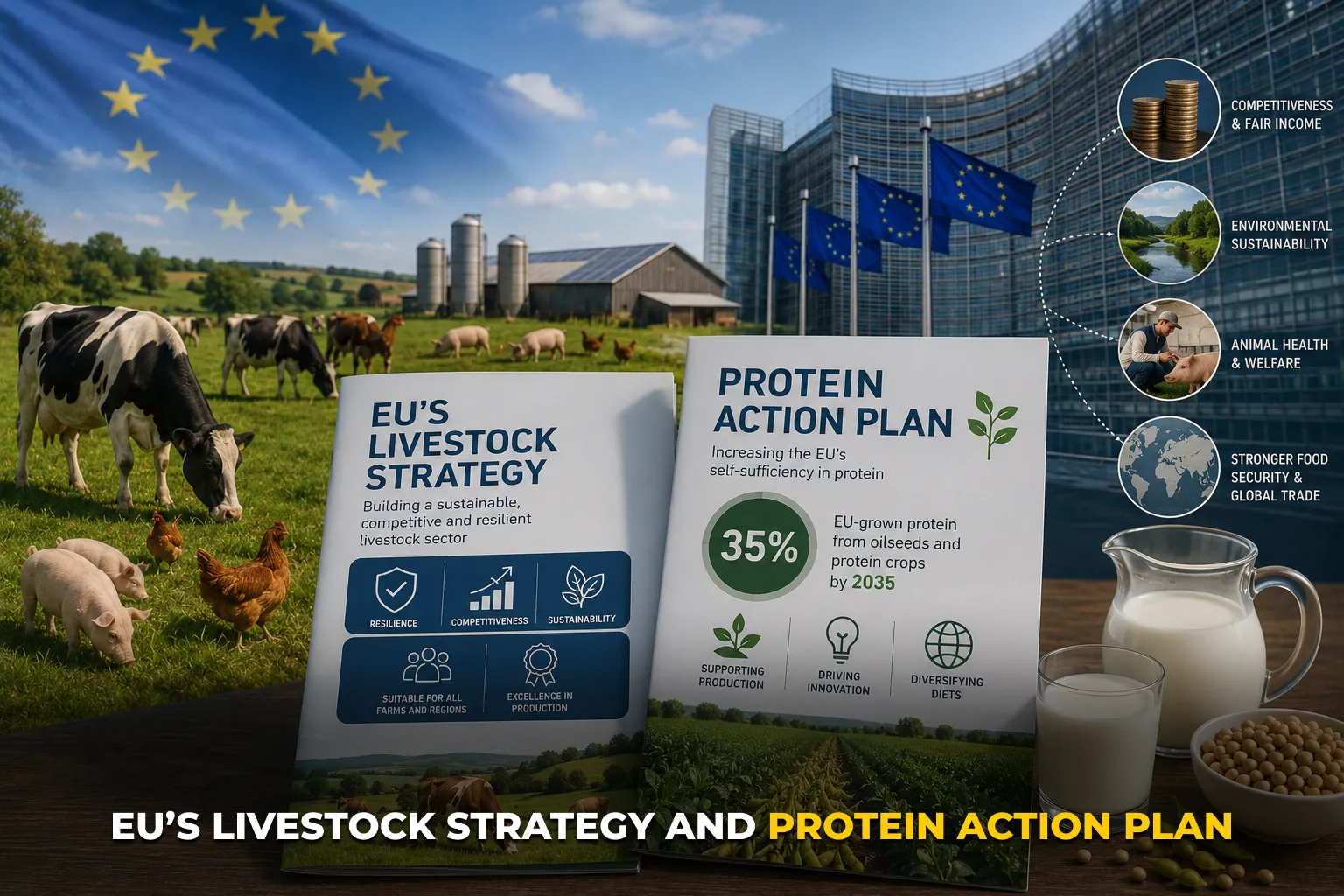
In short, the EC wants Europe’s livestock sector to stay strong and resilient, built on five priorities: resilience to crisis; competitiveness in the EU and globally; sustainability; suitability for all farms and regions; and excellence in production. As an example of the document’s vagueness, it speaks of “stepping up preparedness”, strengthening risk-management tools and exploring a new insurance and re-insurance scheme, plus support for member states on animal-disease prevention.
On profitability, the verb “explore” recurs around financing a move to a cage-free egg system, with the EC to work with bodies such as the European Investment Bank (EIB) on risk-management schemes — again without detail. Other strands promise a tailored sustainability approach, targeted welfare revisions for laying hens, broilers and pigs, harmonised farm-level emissions methods, a return of production to “vulnerable regions”, a roadmap for low-capacity or mobile slaughterhouses, and stronger origin labelling and geographical indications. Copa-Cogeca welcomed the recognition of livestock’s value but said both texts remain focused on assessment, monitoring and benchmarking, making concrete, on-the-ground relief hard to find.
What does the Protein Action Plan entail?
Very little so far. The plan aims to lift the supply and use of EU-grown protein: only 25% of protein from oilseeds and “protein crops” is currently sourced internally, with a goal of 35% by 2035. Protein crops are mainly dry pulses and soya beans, where the EU leans on imports; member states grow plenty of plant protein but largely as roughage and cereals of low-to-medium protein content. The EC pledged to back domestic protein-crop production and competitiveness while encouraging innovation, investment and diversified diets.
With 64% of protein consumed by humans in the bloc animal-based, the European Vegetarian Union’s (EVU) Rafael Pinto argued the target could be met simply by raising human consumption of plant proteins, saying the plan still falls short on concrete measures and calling for an EU Plant-Based Action Plan as the next step. ProVeg’s Hortelano said the absence of human-consumption targets “leaves significant opportunities untapped”, arguing feed and food protein should sit within the same resilience agenda. The EC did acknowledge the market potential of plant-based foods and drinks, while conceding some are ultra-processed foods (UPFs).
Animal welfare
Executive Vice-President Raffaele Fitto flagged society’s “evolving expectations” on welfare, echoed by Hansen and Health and Animal Welfare Commissioner Olivér Várhelyi, with proposals for cage-free eggs and a shift from crates to pen systems for pigs. Hansen said the EC intends a targeted revision to phase out cages for laying hens and broilers, while Várhelyi set a loose timeframe — proposals on hens and broilers by year-end, pigs in 2027 — and a plan to end the systematic killing of male day-old chicks, cautioning that farmers need time and financing, including via the EIB. Copa-Cogeca called the welfare plans among the few truly concrete actions but again faulted the lack of a credible financing roadmap, urging a move from intentions to action within this term.
What about dairy?
Direct mentions of dairy were largely absent, but the European Association of Dairy Trade (Eucolait) welcomed the recognition of the livestock sector’s economic importance and its role in food security and strategic autonomy. Like the others, it criticised the lack of concrete measures, urging coherent policies that balance environmental ambition, economic viability and competitiveness without adding barriers to intra-EU and international dairy trade. Eucolait called for cutting red tape and striking more trade deals, describing strategic export diversification — backed by ambitious free trade agreements and high-level agri-food missions — as essential, and pressed the EU to remove technical and sanitary barriers limiting access to global markets.
Source: Just Food