
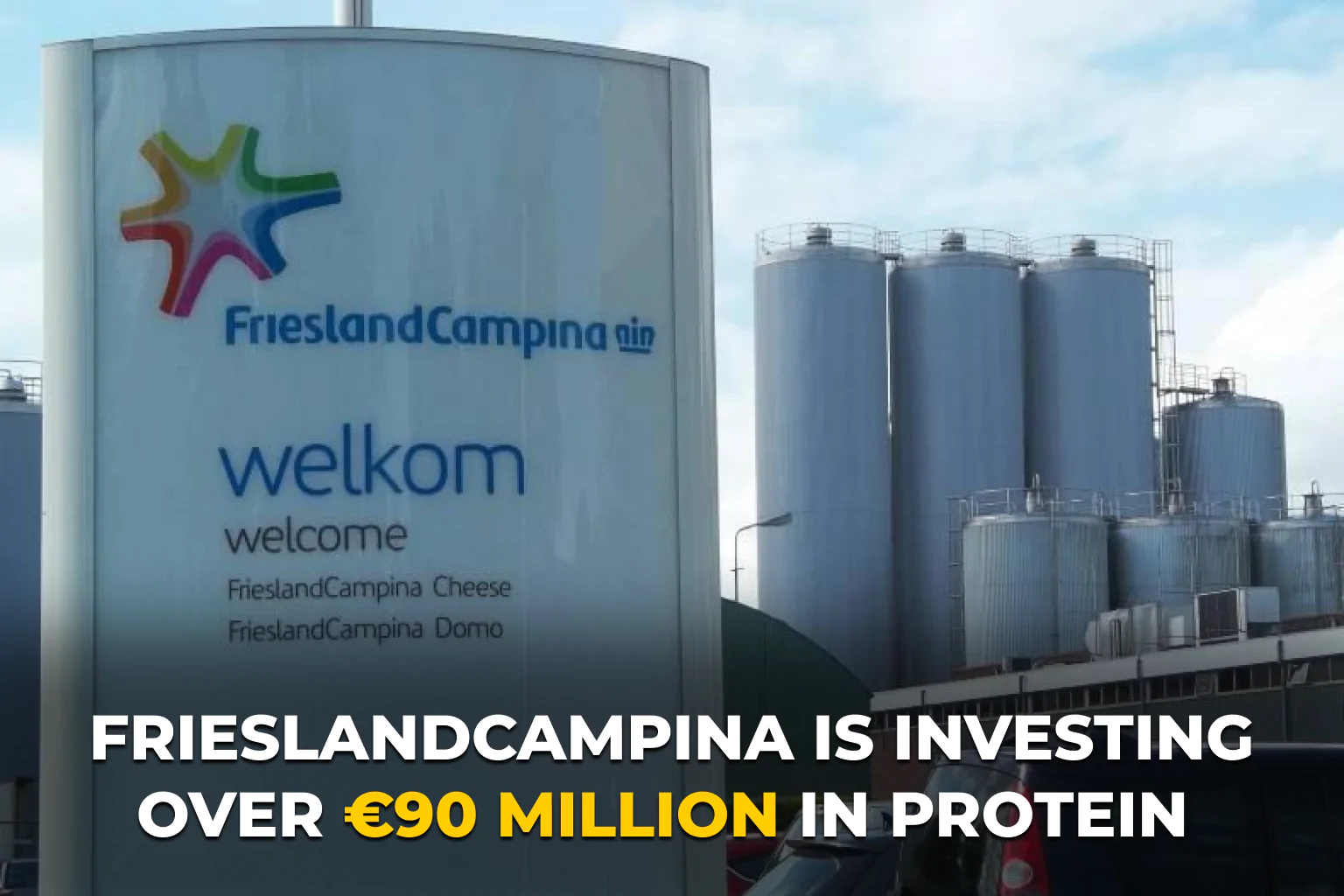
The publication Dairy Reporter reports that dairy giant FrieslandCampina has announced a major investment programme to accelerate the growth of its whey protein segment.
FrieslandCampina Ingredients is investing over €90 million in expanding its capacity to convert in-house whey – a natural by-product of cheese production – into protein ingredients.
The investments include technological upgrades to the production sites in Bedum, Veghel and Workum. The upgrades are aimed at developing the production of advanced ingredients, including WPC80, instantised whey proteins and Nutri Whey™ ProHeat microparticulated whey.
These products are used in high-protein drinks, bars and yoghurts, as well as in the sports nutrition, infant nutrition and medical nutrition sectors — categories in which global demand for high-quality whey protein continues to grow.
The investment programme builds on the company’s previous initiatives. In particular, the plant in Borkulo was previously expanded, enabling the company to double its production capacity for whey protein isolate and fat globule membranes. The company has also acquired Wisconsin Whey Protein.
“Global demand for advanced protein solutions continues to accelerate. This programme is the next step in our broader investment strategy to lead in high-value proteins, building on recent investments to strengthen whey capacity and valorisation in the Netherlands, such as in Borculo, and in the United States through the acquisition of Wisconsin Whey Protein,” commented Anne Peter Lindeboom, president of FrieslandCampina Ingredients.
“By investing across our ingredients network, we are strengthening our ability to serve customers worldwide and to create more value from our whey streams in a sustainable and future-oriented way,” adds Lindebum.
In addition to the economic benefits, the modernisation project also has an environmental dimension. By introducing more energy- and water-efficient technologies, the company expects to reduce emissions by approximately 16 kilotonnes of CO₂ equivalent.
The investment will be implemented in phases over the coming years, with full operational capacity expected to be reached in 2028.
Source: Dairy Reporter