

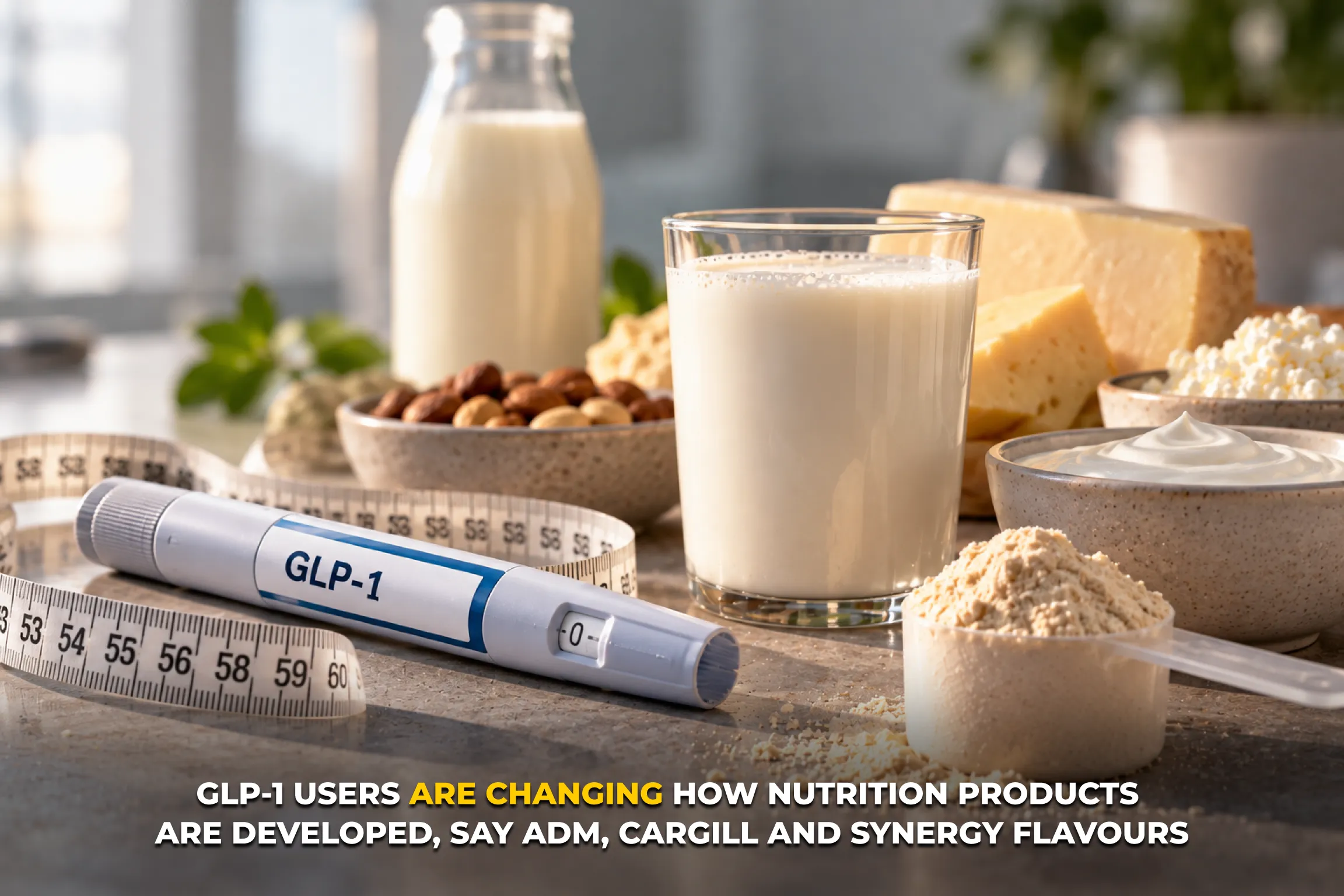
As more people take glucagon-like peptide-1 (GLP-1) weight-loss drugs, manufacturers are rethinking recipes to pack more protein and fibre into smaller portions, with smoothies and drinkable yogurts emerging as convenient formats for these consumers, Nutrition Insight reports.
Key points:
- Gallup data show 11% of US adults took GLP-1 medications for weight loss in 2026, up from 3% in 2024, reshaping how the nutrition industry develops new products;
- Cargill, ADM and Synergy Flavours say users need protein for muscle maintenance, fibre for gut health, and vitamins and minerals to fill nutritional gaps;
- ADM points to cost and supply constraints on traditional dairy proteins such as whey, and to demand for lighter textures such as smoothies, protein drinks and drinkable yogurts;
- the suppliers call for systemic reformulation that accounts for shifts in taste and texture, and expect these behaviours to spread into mainstream personalised nutrition.
GLP-1 use keeps rising
The use of GLP-1 medications for weight loss continues to grow. According to the Gallup National Health and Well-Being Index, 11% of adults in the United States (US) took these drugs for weight loss in 2026, compared with 3% in 2024.
Experts from ADM, Synergy Flavours and Cargill told Nutrition Insight how this is changing the industry’s approach to product development, outlining the nutritional challenges facing users, key formulation considerations and their expectations for the evolving GLP-1 companion nutrition market.
What matters to anti-obesity medication users
Bastian Hörmann, senior marketing director at ADM, says the growing adoption of anti-obesity medications (AOMs) such as GLP-1s raises new questions around food, nutrition and portion sizes.
«Globally, 67% of current AOM users state GLP-1 friendly attributes matter more since starting medication, and 80% are willing to pay more for products with added health benefits», he says, citing ADM Outside Voice data from its 2025 Anti-Obesity Medication Users Landscape Report.
«Nearly 70% of AOM users say nutritional value is now more important to them, and they’re paying closer attention to protein and fiber content. GLP-1 users also report feeling full more quickly, and they place greater importance on portion control».
Chris Whiting, European category development manager at Synergy Flavours, adds that new products must appeal to this fast-growing audience without alienating existing consumers who do not take GLP-1 drugs.

«A consumer survey by Synergy Flavours found that GLP-1 users report that vitamins, followed by protein, fiber, and minerals, are the hardest nutrients to obtain from food alone, and as such, 95% of GLP-1 users are supplementing their diets to ensure adequate intake».
«Protein in particular is the biggest focal point for many GLP-1 consumers, with 55% of users saying they struggle to meet protein needs, leading many consumers to supplement», Whiting adds. «With nearly two-thirds of users aiming for at least 100 g of protein per day, protein fortification in food products can help users to overcome these challenges».
A more flexible relationship with food
Aysegul Ozcan, Enhanced Nutrition commercial marketing director at Cargill, says GLP-1 drugs are accelerating a wider shift in how the industry approaches nutrition and product development as eating habits change.
«Manufacturers are having to think more carefully about how much nutrition can be delivered within different portion sizes and eating occasions, while recognizing that consumers still expect convenience and enjoyment».
Cargill is seeing consumers move towards a more individual and flexible relationship with food, she says.
«Smaller portions and changing eating occasions can alter what consumers expect from a product, with nutrition, convenience, portion size, and enjoyment all becoming part of the decision».
Understanding these shifts means looking at the consumer experience as a whole — behaviour, nutrition and sensory preference together, Ozcan explains.
«To build a more connected picture, Cargill and isi developed a research program that examines the evolving food landscape from several complementary perspectives, bringing together insights into consumer experiences, changing behaviors, nutrition, and sensory expectations».
«Consumers increasingly want food to do more for them while still fitting into the realities of everyday life», she adds. «For manufacturers, that means looking beyond individual nutritional attributes to understand how nutrition, taste, convenience, and format can work together across changing routines and eating occasions».
Tackling nutritional challenges
ADM’s research shows muscle maintenance, digestive discomfort and hydration are the main concerns of people on weight-loss medications, Hörmann says.

«Clinical research estimates 20–40% of weight loss comes from muscle, highlighting demand for increased protein density to support muscle maintenance».
At the same time, manufacturers face cost and supply constraints on traditional dairy proteins such as whey. Hörmann notes that soy offers a high-quality protein that can complement or replace whey, citing ADM’s new ProFam 883 soy protein isolate, with 90% protein content, good dispersibility and medium-to-low viscosity.
«When it comes to digestive health, consumers are increasingly aware of the role fiber can play to support their gut and digestion, along with metabolic health, satiety, and appetite regulation», he adds.
He highlights Fibersol Prebiotic dietary fibre from ADM/Matsutani LLC, which clinical research suggests may support gut health.
«When consumed at 10 g with a meal, Fibersol may increase the appetite-regulating hormone GLP-1 as part of a normal physiological response in healthy individuals».
Brands can also add other biotic solutions for gut and metabolic health, Hörmann says, pointing to clinical findings that ADM’s Esflorin1 (Bifidobacterium longum CECT7347) probiotic and postbiotic may support overall gut and digestive health, while the BPL1 (B. animalis subsp. lactis CECT8145) probiotic and postbiotic target aspects of metabolic health.
Reformulating as a system
Reformulating for GLP-1 users is challenging because a single product has to meet several requirements at once, says Cargill’s Ozcan.
«Nutrition, portion size, taste, texture, and functionality all need to work together to create products that fit changing consumer needs and everyday eating occasions».
«Increasing protein or fiber, reducing sugar, or adjusting portion size can all affect taste, texture, mouthfeel, sweetness, and stability», she notes. «Manufacturers also have to consider cost, regulatory requirements, and scalability, so changing one element of a formulation can have implications across the entire product».
At Vitafoods Europe 2026, Cargill showcased product concepts illustrating how it treats formulation as a system rather than a series of one-off ingredient swaps, designed around nutrient density, portion flexibility and sensory experience.
One example is VitalFuel, a nutrient-dense cocoa drink delivering protein and fibre in a smaller, more manageable serving of about 250 ml.

According to Ozcan, the drink combined plant protein and fibre with phosphatidylcholine lecithin, Gerkens Sweety cocoa powder and Eversweet stevia sweetener — made by Avansya, a joint venture of dsm-firmenich and Cargill.
«The aim was to show how manufacturers can bring together nutritional priorities with familiar taste, texture, and convenience in a smaller-format product».
Taste and texture perceptions
A Synergy Flavours survey found that 72% of GLP-1 users noticed some change in taste perception while on the medication, Whiting says. Reports ranged from vague changes in how certain flavours taste to specific sensitivities to sweetness and bitterness.
«For many consumers, taste is the primary driver of repeat purchases, so these changes in taste perception will lead many GLP-1 consumers to rethink the products they purchase», he cautions.
He therefore advises manufacturers to make sure ingredient replacements or fortification do not compromise taste.
«For example, as many GLP-1 users report a sensitivity to sweetness or bitterness, the use of artificial sweeteners can trigger this sensitivity, with high sweetness or a bitter aftertaste».
«Fortification can also bring additional challenges, with protein being notorious for introducing a dry or chalky mouthfeel when added to products», Whiting adds. «Adopting specialty taste modulation solutions can mask bitter off-notes, improve sweetness perception, and also help to overcome mouthfeel and texture challenges when developing enriched products».
ADM’s Hörmann adds that because weight-loss drugs make users feel full sooner, dry or heavy foods can quickly become unappealing or hard to finish.
«Lighter and smoother textures, such as smoothies, protein beverages, and drinkable yogurts, make formats easier to consume, without overwhelming the palate».
Citing ADM Outside Voice’s 2026 Texture Report, he says solid snacks such as nutrition bars also benefit from a smoother mouthfeel: 98% of GLP-1 consumers rate gooeyness as important — significantly more than non-AOM users.
From GLP-1s to everyday life
Over the next few years, Cargill expects the discussion to move beyond a distinct category of GLP-1 products.
«Some of the behaviors emerging around changing appetites, portion sizes, and eating occasions may have much wider implications for food and beverage innovation», Ozcan notes. «That could increase the focus on nutrient-dense foods, protein and fiber enrichment, portion flexibility, reduced sugar, and convenient formats».
Yet the opportunity is broader than any single ingredient or nutritional attribute, she says.
«Ultimately, we see this as part of a wider evolution toward more personalized nutrition and greater choice, rather than the creation of a single type of product for a single consumer group».
Whiting adds that eating habits will keep shifting as GLP-1 use for weight management grows, directly affecting how manufacturers develop and market new products.
«We expect to see food and beverage manufacturers invest more time and innovation in better-for-you products that showcase nutrition enrichment in convenient everyday formats, such as high-protein breads, fiber-enriched yogurts, and portion-controlled snacks».
He also expects a marketing shift away from sensitive callouts such as «diet» towards more empowering messages that highlight nutritional benefits, such as «complete nutrition in a smaller serving».
Source: Nutrition Insight