
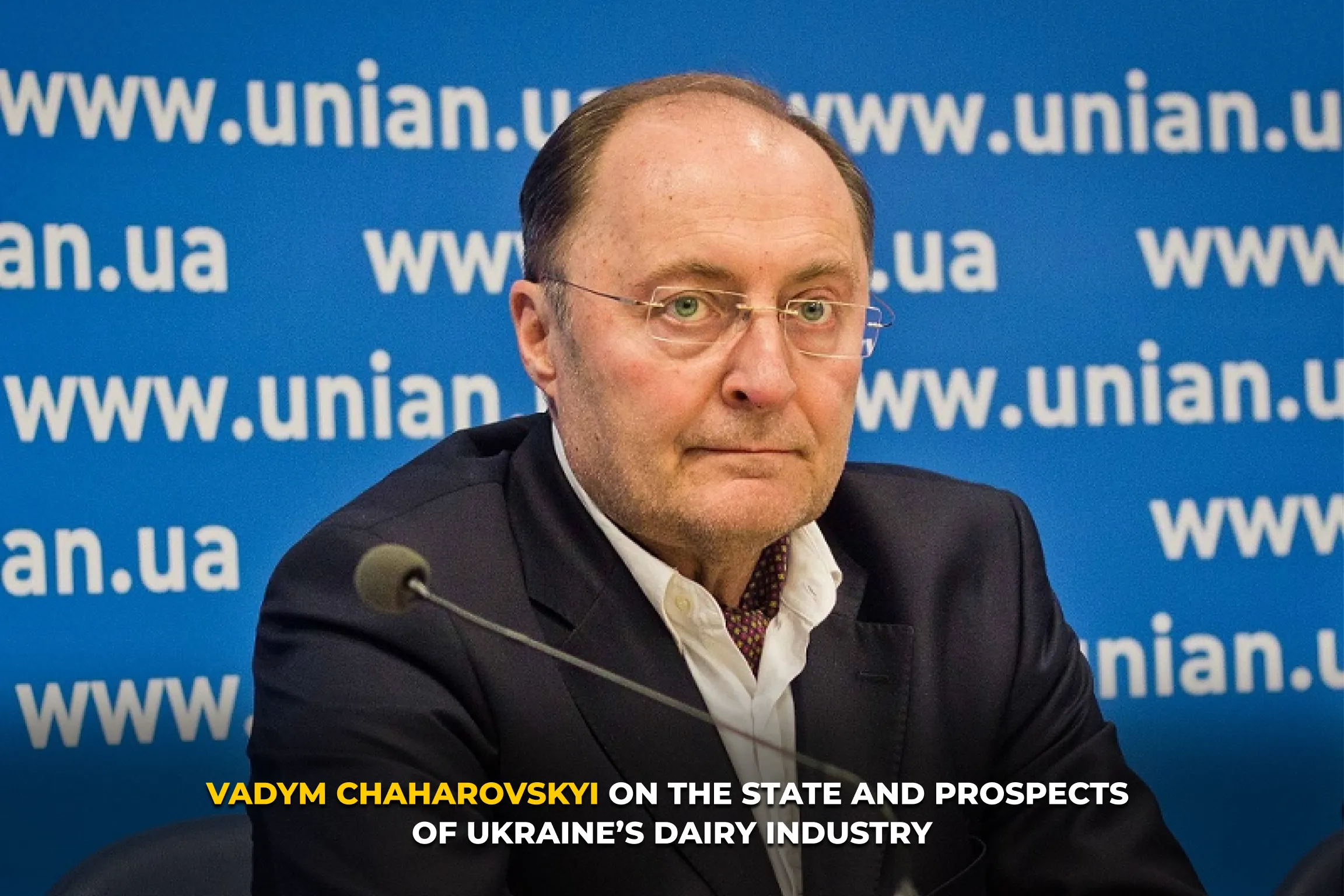
Vadym Chaharovskyi, Chairman of the Board of Directors of the Union of Dairy Enterprises of Ukraine (UDEU), spoke at the International Practical Forum «DAIRY FARMING INDUSTRY: Challenges. Risks. Changes. Solutions», held in Lviv on 7–8 October. He gave participants a detailed overview of the current state of Ukraine’s dairy sector and its main development trends, and also addressed wartime challenges and prospects on the road to the European Union (EU).
His presentation was followed by a panel discussion he moderated, covering pricing, relations between milk producers and processors, development of the raw milk base, the fight against the shadow market and the changes needed in state policy.
Key points:
- as of 1 January 2026, Ukraine had produced about 6.9 million tonnes of milk; dairy output was worth UAH 124 billion and exports about USD 214 million;
- in January–August 2026, milk production on commercial dairy farms rose by about 5%, while household production fell by 27%;
- the 2035 vision envisages 10 million tonnes of milk, 700 modern farms and around USD 15 billion of investment;
- proposed market solutions include long-term contracts, a transparent price formula, a standard contract and raw milk clusters.
Where Ukraine’s dairy industry stands today
According to figures presented by Chaharovskyi, Ukraine had produced around 6.9 million tonnes of milk as of 1 January 2026. Dairy production was worth UAH 124 billion, and exports reached about USD 214 million.
The data also reveal structural change in the sector: cow numbers in households continue to fall, while commercial dairy farms are increasing output.
Chaharovskyi called the growth of the organised sector one of the industry’s positive signals. In recent years, he said, Ukrainian dairy farms have significantly improved productivity, milk quality and technology.
Average yield in 2025 was about 8.6–8.7 tonnes of milk per cow, and the content of key solids — fat and protein — is also rising. In his view, this shows that Ukrainian dairy farming has the potential to become more competitive still.
What the industry could look like in 2035
Part of the presentation set out a ten-year vision for Ukraine’s dairy industry. Key targets include raising milk production to 10 million tonnes and processing to 8 million tonnes, adding 750,000 head of cattle, building around 700 modern high-tech farms and delivering at least 40 new investment projects.
The vision also foresees about USD 6 billion of investment in processing and USD 9 billion in livestock and herd development. Under this scenario, the dairy industry’s share of Ukraine’s gross domestic product (GDP) could rise from 0.25% to 0.75%. Chaharovskyi stressed, however, that such results are impossible without consistent state policy.
UDEU has drafted an industry development strategy that is now under discussion. Proposed areas include support for herd growth and farming, modernisation of processing, stimulating domestic demand, protecting the domestic market, export finance and promotion of Ukrainian products.
«Without prioritising the dairy industry at state level, the dairy industry will have no prospects for development», Chaharovskyi said.
Growth comes where modern farms are
One of the central conclusions of the presentation was the divergence between the industrial and household sectors.
Milk production on commercial dairy farms has been rising in recent years, Chaharovskyi said, whereas households are seeing a steep decline in both output and herd size. The trend became especially visible in 2026: in January–August, farm production grew by about 5%, while household production fell by 27%.
The geography of production is shifting too. Growth is concentrated mainly in western Ukraine, notably in the Khmelnytskyi, Ternopil, Volyn and Lviv regions, while frontline regions are suffering much heavier losses.
Another important marker of structural change is that commercial dairy farms have, for the first time, overtaken households in their share of milk production.
Processing, milk prices and the global market
In 2025, Ukraine for the first time exceeded pre-war volumes of milk delivered for processing, Chaharovskyi said. Deliveries in 2026 are forecast at about 3 million tonnes.
Raw milk prices, however, are shaped by more than the domestic market. Ukraine’s dairy sector is already integrated into the global market, so world conditions directly affect domestic milk prices.
Chaharovskyi noted the change in the price situation in autumn 2026, saying positive momentum had emerged on the global market after an unfavourable period. He argued that the industry needs to move away from an ad hoc approach to pricing, with milk prices reflecting global market indicators as well as domestic demand.
Counterfeits and the shadow market remain a systemic problem
A separate part of the presentation dealt with counterfeit products and the shadow segment of the dairy market. Chaharovskyi recalled that UDEU has long worked on this problem: in 2019–2020 it launched the «Stop Counterfeit» campaign, after which the Antimonopoly Committee imposed significant fines on producers of falsified products.
Fines alone, however, do not solve the problem. What is needed are effective state control mechanisms, the ability to revoke operating permits quickly and clear legal definitions of «falsification» and «food fraud».
He also cited limits on state inspections under martial law, shortcomings in some regulations and insufficient traceability of raw milk as reasons counterfeits have spread.
Chaharovskyi underlined the importance of fully functioning state registers of livestock facilities, cattle and market operators. Transparency of milk origin, he said, should become one of the key tools against the shadow sector.
European integration: modernisation and new rules
Chaharovskyi also addressed the challenges European integration poses for the dairy industry: some segments lagging behind EU standards, a lack of funding for modernisation, logistics and infrastructure problems, staff shortages, uncertainty over the future model of small-scale production and bureaucratic barriers.
At the same time, he urged against viewing Ukrainian dairy processing as technologically backward. More than a dozen Ukrainian plants, he said, have already undergone large-scale modernisation and meet current global standards.
Strategic tasks include further harmonisation of Ukrainian legislation with EU rules, modernisation of enterprises and accessible financial instruments for business.
Small producers’ future lies in family farms and cooperation
Chaharovskyi named the future of household farms as one of the most difficult issues. In his view, the current model of small-scale production is gradually running its course. One alternative would be to turn households into family dairy farms with roughly 15–50 cows — but that requires land, access to finance, state support and cooperation.
Pointing to large European dairy cooperatives, he said cooperation among producers helps build a stable raw milk base, use resources more efficiently and strengthen farmers’ bargaining power.
Staff and education — another strategic challenge
Among the industry’s long-term problems, Chaharovskyi highlighted the shortage of personnel: the number of actually operating dairy plants is falling, skilled staff are ageing and young specialists are scarce.
He called for reform of professional training: developing dual education, bringing back industrial placements, creating postgraduate programmes and concentrating resources in specialised universities.
In particular, he argued that training in dairy processing technology should not be spread too thinly across dozens of institutions. Concentrating facilities and teaching staff could improve the quality of future specialists.
From presentation to a debate on the industry’s future
After the presentation, Chaharovskyi invited Dmytro Hlushchenko (PSP «Ukraina», Eridon Group), Vitalii Kolodii (PrJSC «Ternopil Dairy Plant (Molokiya)») and Mykhailo Travetskyi («Velesova Ferma») to join him, and moderated the discussion «Balance of interests: how milk producers and processors can stay profitable in an unstable market».
It is the most pressing issue on the dairy market: how producers and processors can remain profitable amid volatility.
The debate centred on relations between milk producers and processors. Participants discussed raw milk shortages, unstable pricing, the role of retail chains, the shadow market, the impact of heavy imports and the need to move from ad hoc competition to long-term cooperation.
Milk pricing was a key topic. Participants agreed that prices cannot be set solely by the short-term situation on the domestic market, as Ukraine’s dairy sector increasingly depends on world prices with a significant share of output exported. At the same time, producers need predictability, and processors need to be able to plan costs and production.
Long-term contracts and a price formula
Long-term contracting was named as one possible solution: agreements that set delivery volumes, quality requirements and the pricing principle in advance. This gives producers guaranteed sales and processors a predictable raw milk supply. A key element, participants said, should be a transparent price formula linked to objective market indicators.
The panel also discussed a standard contract between producer and processor, setting out mutual obligations, the procedure for price revisions, notice periods for changes and liability for breaches.
Developing a civilised spot market for raw milk was named as another possible tool.
From competing for milk to raw milk clusters
An important theme of the discussion was the creation of raw milk clusters — stable supply zones around processing plants where producers and processors work in long-term partnership.
Such a model could cut logistics costs, give processors predictable volumes and end the constant poaching of suppliers over small differences in purchase prices.
Participants acknowledged, however, that moving to a cluster model will take time. With milk in short supply, producers and processors remain competitors for raw milk for now.
Shadow market, imports and protecting Ukrainian producers
The discussion paid particular attention to intermediaries and informal milk trade. On the one hand, they provide a sales channel for small farms; on the other, opaque channels can allow milk to circulate without proper quality and origin control.
Participants also discussed the excessive presence of imported dairy products, especially from Poland, on the domestic market and the competitiveness of Ukrainian producers. The focus was not only on fighting smuggling and counterfeits, but also on creating a level playing field for Ukrainian and imported products.
Unfair trading practices were raised as well: long payment delays, high demands from retail chains and the shifting of operating costs onto suppliers.
The industry needs common rules of the game
Moderating the debate made it possible to move from individual problems to a broader question: what development model Ukraine’s dairy sector should follow.
Participants effectively agreed that no single party can solve the problems alone. The industry’s stability depends on the coordinated development of milk production, processing, logistics, retail and state regulation.
Key directions outlined during the discussion included:
- developing raw milk clusters;
- long-term contracts between producers and processors;
- introducing a transparent pricing formula;
- creating a standard contract between the parties;
- developing a civilised raw milk market;
- fighting the shadow trade and counterfeits;
- strengthening state control;
- a level playing field for Ukrainian and imported products;
- countering unfair trading practices;
- supporting family farms and cooperation;
- developing high value-added products;
- stimulating consumption of dairy products.
Dairy as a strategic sector
Chaharovskyi’s presentation and the discussion he moderated showed that Ukraine’s dairy industry is undergoing a structural transformation.
On the one hand, war, shrinking household herds, staff shortages, high input costs, logistics problems and unstable pricing pose serious risks. On the other, modern dairy farms are increasing output and productivity, processors are modernising and Ukrainian dairy products are becoming ever more integrated into the global market.
The key task for the next stage, the speech and debate concluded, is to establish clear, long-term rules of the game for the entire dairy chain — from farm to shelf.
A balance of interests between producers, processors, retail and consumers, backed by consistent state policy, could become the foundation for achieving the ambitious vision for Ukraine’s dairy industry by 2035.
Source: UAdairy.org