

«Nutritionally complete» drinks are designed to give consumers every nutrient they need — but their role can go well beyond that.
Meal replacement drinks are usually sold on convenience, yet they can also deliver complete nutrition and keep consumers full, provided individual needs are taken into account, DairyReporter reports.
Key points:
- meal replacement drinks offer convenience and can provide complete nutrition;
- a fully liquid diet is not inherently harmful for everyone;
- nutritional adequacy needs enough calories, not just vitamins and minerals;
- satiety depends on fibre, protein, texture, eating speed and energy;
- long-term exclusive use may call for an individual dietetic assessment.
Convenience first
Meal replacement drinks are most often promoted for how convenient they are.
Brands such as Huel and Yfood describe their products as «nutritionally complete» or as a «complete meal» — in effect, a substitute for part of the diet.
With consumers seeking ever more convenience (it has emerged as a trend across Europe even where other eating habits differ), these drinks offer a useful alternative to sit-down meals.
They can stand in for a large share of what a consumer eats. The question is how far that can go.
Liquid diets are not «inherently harmful»
Specialist dietitian Nichola Ludlam-Raine says that while «an everyday meal replacement shouldn’t automatically be assumed suitable as someone’s sole nutrition», a diet made up entirely of liquids is not «inherently harmful».
In nutritional terms, liquids can often do the same job as solid food. Absorption depends not on whether a nutrient is solid or liquid, but on its chemical form, how it is prepared and what it is consumed with.
Ludlam-Raine also notes that solid food is not medically essential for everyone, and people who cannot eat it can often manage on a fully liquid diet.
A nuanced picture
If a consumer swapped solid meals for meal replacement drinks, the effects would be mixed.
«Complete at what daily intake, and suitable for whom? That label needs context», Ludlam-Raine says.
Calories matter in particular: consumers need to be sure the drinks supply enough energy as well as the right nutrients.
«Calories are themselves part of nutritional adequacy: meeting vitamin and mineral requirements doesn’t compensate for inadequate fuel».
A prolonged, significant energy deficit can cause fatigue, muscle loss and slower recovery, and in active people low energy availability can even affect reproductive function and bone health.
Gut health
Depending on their composition, meal replacement diets may also affect gut health, Ludlam-Raine says — although the amount and type of fibre and individual tolerance matter far more than the liquid format itself.
Some studies of formula-only diets have found shifts in gut bacteria and bowel habits linked to added fibre. But, she stresses, changes in the microbiome are not in themselves harmful.
And even if a drink contains every required nutrient, it «may not reproduce the range of fibres, plant compounds and food structures found across a varied diet».
Do they keep hunger at bay?
People eat not only to get nutrients, but also to stop feeling hungry.
About 31% of consumers regard a drink as a snack if it is filling enough, according to Marieke Bokkes, market analyst at Innova Market Insights.
Consumers increasingly expect drinks to perform like snacks, at least when it comes to fullness.
«Drinks are being judged on hunger now, not just refreshment», Bokkes says.
So can meal replacement drinks meet that expectation?
In short, yes. They «can be filling, particularly when they provide adequate energy, protein and fibre», says Ludlam-Raine.
But satiety is complex.
«Fullness involves several signals: stomach stretching, nutrients reaching the intestine, gut hormones, texture and eating speed».
So results vary from person to person.
A food’s physical structure can shape digestion and fullness, and for some people chewing and food form influence appetite. Some studies have found liquid meals less satisfying than solid equivalents.
Still, «it’s too simplistic to say that drinks cannot satisfy hunger or that volume alone controls satiety», Ludlam-Raine says.
How long can drinks replace food?
There is no defined upper limit on how long someone can live on meal replacement drinks instead of food, according to Ludlam-Raine.
Medically indicated formula feeding, she says, can continue for long periods as long as it is monitored.
That does not make replacing a whole diet with shakes simple or easy.
«I wouldn’t recommend indefinite exclusive use of an everyday consumer shake without individual dietetic assessment».
Meeting consumer needs
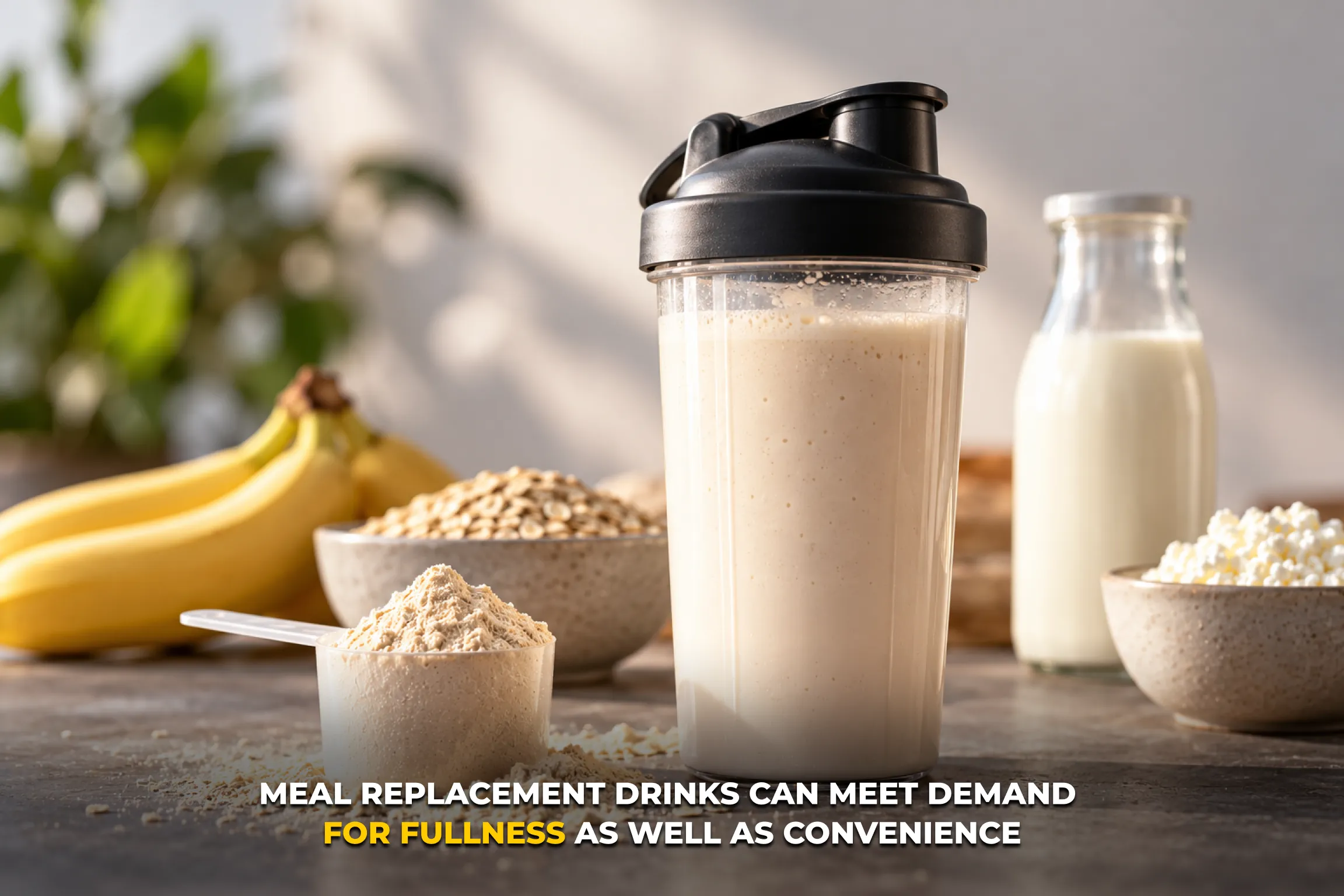
Meal replacement drinks can go a long way towards meeting consumer needs — not only convenience, by supplying nutrients that would otherwise come from food, but fullness too.
Ultimately, they are best seen as they are marketed: able to deliver nutrition and satiety, but with individual requirements and responses in mind when they are used heavily in place of meals.
Source: DairyReporter