
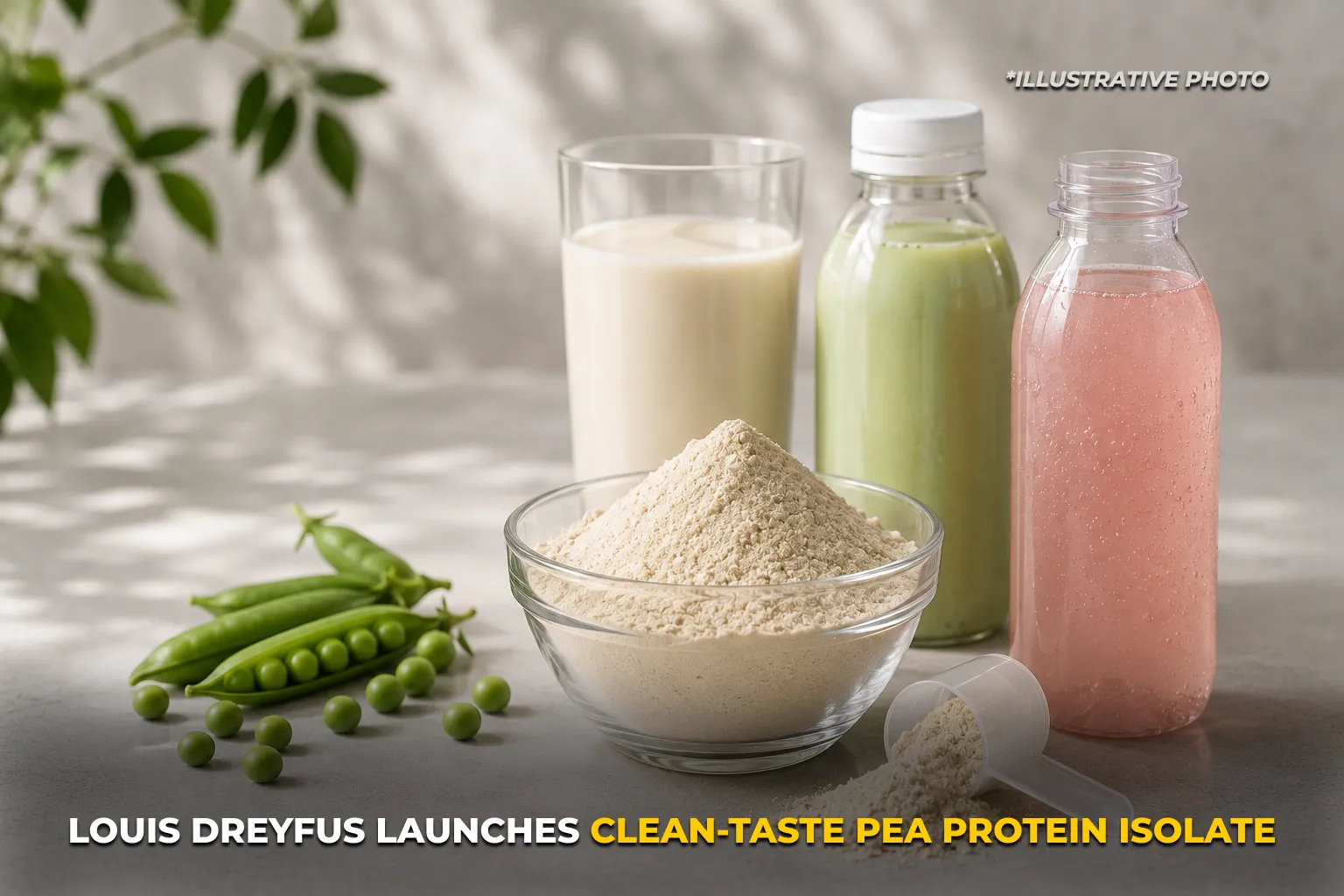
Demand for plant-based dairy, protein sodas and ready-to-drink sports beverages is surging — but CPG companies still face sensory off-notes from pea proteins. Louis Dreyfus Company has launched large-scale production of a purified pea protein isolate to remove that barrier.
Ready-to-drink (RTD) sports beverages, plant-based dairy and protein-packed sodas are exploding in popularity, but CPG companies still face a sensory setback of off-notes associated with pea proteins. The issue has prompted Louis Dreyfus Company (LDC) to advance its two-pillared strategy: “Reinforce and Integrate,” Dairy Reporter reports.
Known for its 175-year history in bulk agricultural commodities — grains, sugar, coffee and cotton — the company this summer opened one of North America’s largest pea processing plants in Yorkton, Saskatchewan, Canada, with a focus on high-end pea protein isolate (PPI) as part of its strategy of integrating value-added downstream products.
Pea protein isolate set for growth
The growth is logical, considering the sector’s projected compound annual growth rate (CAGR) of 12.51% globally over the next eight years, according to Fortune Business Insights. The global industry reached $815 million in 2026 and is estimated to grow to nearly $2.1 billion by 2034.
PPI and pea protein concentrates (PPC) are expected to grow significantly, driven by fast-gaining popularity among vegans, vegetarians and people allergic to egg and dairy proteins. They are hypoallergenic and free of cholesterol, fat and gluten. Peas also have an appetite-suppressing effect — they can delay stomach emptying, reduce glucose absorption and facilitate the release of appetite-regulating hormones. They also help convert fatty acids into energy, thereby reducing cholesterol levels in the body.
Pea protein on display
Pea protein isolate’s wide range of applications was on display at IFT FIRST in Chicago in mid-July, where LDC featured creations such as a Mango Peach Protein Soda, a High-Protein Ready-to-Mix (RTM) GLP-1 Lemon Shake, and Plant-Based Milk with Pea Protein and Plant Sterols, among others.
“Food manufacturers are trying to fill the consumer desire for high-quality foods with a clean, mild taste,” said Charles-Antoine Dubois, global head of plant proteins at LDC.
Manoj Kumar, vice president and chief technical officer for LDC’s plant proteins business, has been working for the last five years to develop the pea protein isolate the company now manufactures at its new large-scale facility in Yorkton, Saskatchewan, which opened in July.
“It’s a new process in order to have a very clean taste and to address this demand for higher-quality pea protein for our customers, and to unlock some segments — because in some segments today you cannot use pea protein because the products existing in the market are not good enough. So now with this protein, it will be able to address some new segments,” Kumar said.
Pea protein isolate
LDC has its own proprietary method for developing pea protein isolates and concentrates, but the ingredient is known in the industry for its greater purity and functionality relative to its non-isolate counterpart. Ingredient marketplace Nutrada describes PPI and PPC as “different grades of the same source material, separated by protein content and processing intensity.”
“Isolates contain 85–95% protein by dry weight; concentrates contain 50–70%. The difference is achieved through additional purification steps — typically membrane filtration, ion exchange or acid precipitation — that remove more fat, fiber, carbohydrates and anti-nutritional factors. For food manufacturers, the choice affects protein density, functional properties, taste, cost and label positioning,” according to Nutrada.
RTDs and snack bars
“Right now, the fastest-growing segment is the high-protein ready-to-drink (RTD) and high-protein ready-to-mix (RTM) type of products, as well as the snacks and snack bars segments,” Dubois said.
Kumar noted that the market for high-protein drinks is driven in large part by the GLP-1 trend and the subsequent muscle loss associated with weight-loss drugs. LDC has designed specialty GLP-1 formulations to highlight the pea protein isolate’s capabilities.
“We’re basically helping move towards that direction, so that people have a good companion product to go along with when they are on a GLP-1 regimen,” Kumar said.
Source: Dairy Reporter