
Not everyone digests milk the same way, and for some it causes discomfort. A2 milk can be a solution — unlike A1, it does not release the peptide linked to these problems during digestion. As Yumda reports, the Remugant Research Group (G2R) from the Animal Science Unit of the Universitat Autònoma de Barcelona has investigated faster, less labour-intensive ways to analyse and differentiate A2 from A1 milk.
Analyse and differentiate between A2 and A1 milk more quickly, with fewer staff required
In recent years, A2 milk has gained prominence among consumers and producers. Its key difference lies in a natural variant of β-casein: unlike A1 milk, A2 does not release the peptide β-casomorphin-7 (BCM-7) during digestion, which has been linked to gastrointestinal discomfort in some people after consuming conventional milk.
As interest grows, many farms are choosing to produce A2 milk. Traditional genetic methods such as PCR and chromatography are accurate but require time, reagents, and specialist staff — making them impractical at scale. This creates demand for a fast, cost-effective, and reliable authentication method.
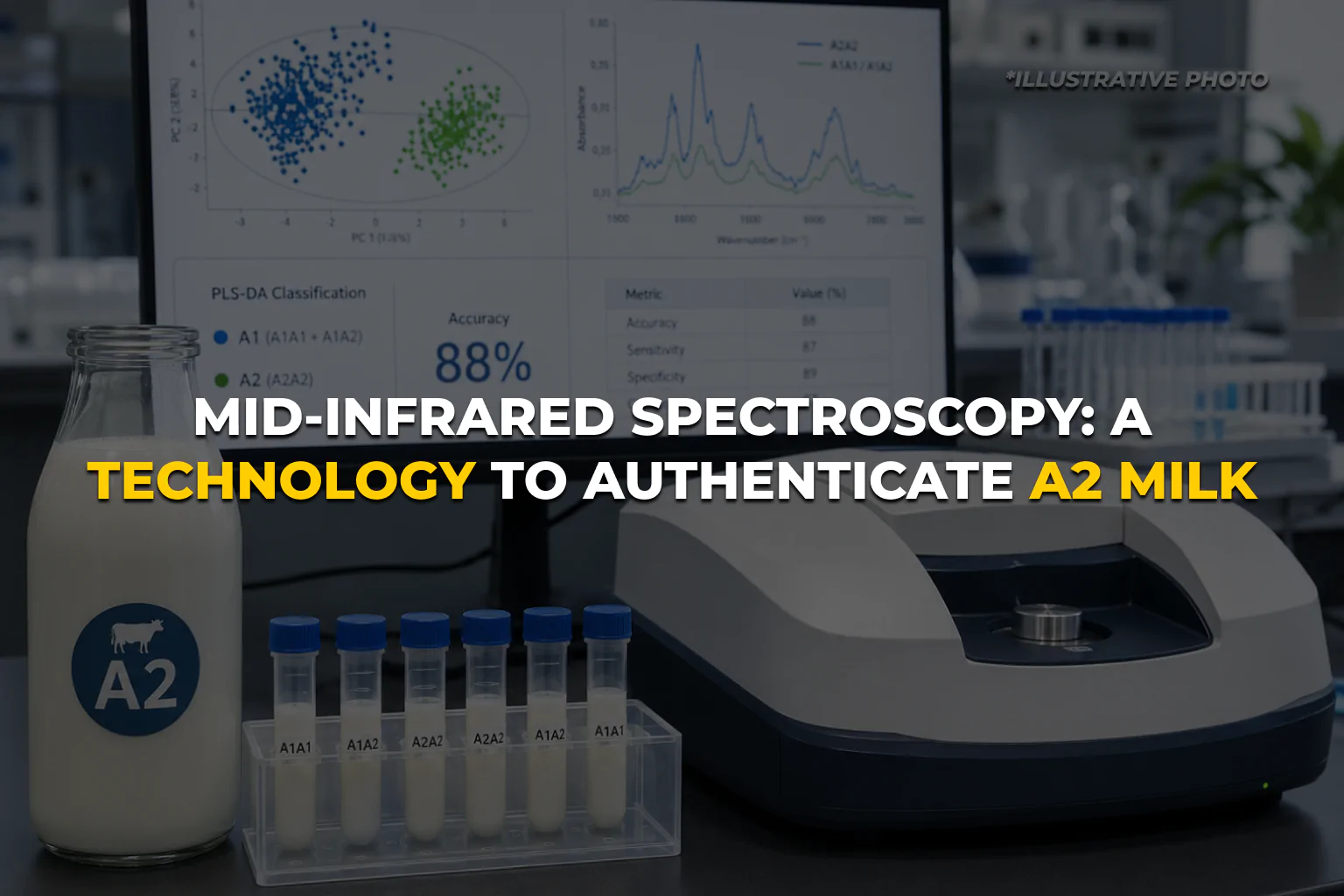
The researchers evaluated mid-infrared spectroscopy (MIR), a technology already widely used in the dairy industry for milk composition analysis. MIR requires no reagents, is fast, and can handle large sample volumes — making it an appealing candidate that can be integrated into existing control systems.
The study analysed over 2,200 milk samples from Holstein cows across six dairy farms in Catalonia. For each sample, the team gathered genetic data, milk quality information, and MIR spectra. An initial exploratory analysis (PCA) did not clearly distinguish between A1 and A2, as the differences in β-casein variants are subtle and do not significantly affect overall milk composition. However, a supervised model (PLS-DA) delivered strong results: grouping samples into A1 milk (A1A1 and A1A2) and A2 milk (A2A2) yielded 88% accuracy in the test set.
The findings suggest MIR can capture signals associated with the β-casein genotype and — with appropriate models — serve as a fast, reliable tool to authenticate A2 milk in routine controls, strengthening transparency for both producers and consumers.
Source: Yumda