
The continuation of the interview with Liudmyla Tsyganok, founder of ESG Liga. In this second part, we discuss the circular economy, the risk of greenwashing, the role of the state, the impact of the war on ESG transformation, as well as where the dairy sector is actually losing the most money and what it should look like in five years’ time.
What role does the circular economy play in the sustainable development of the dairy sector?
For dairy, the circular economy is not a beautiful concept — it is a potential source of savings and new products. Organic residues, whey, manure, wastewater sludge, packaging — all of this can either be costs and risk, or a resource. Whey can be a wastewater treatment problem, or a raw material for value-added products.
Manure can be a source of odours and regulatory problems, or part of a composting or biogas model. Packaging can be a future compliance problem, or a competitive brand position.
What should Ukrainian dairy companies adopt first from European experience?
Not presentations — data management systems. European companies have long moved toward measurable targets, resource controls, supplier engagement, traceability and linking sustainability to business strategy. The European Dairy Association speaks of sector commitments to emissions reduction, a pathway to net zero by 2050, circular economy, responsible water use and sustainable packaging.
Ukrainian companies should adopt not just the ambitions, but the mechanics: how they measure, who is responsible, how they verify, how they link targets to investments and how they explain progress without embellishment.
Do you see a risk of greenwashing in the Ukrainian dairy sector?
Yes, the risk exists — when a company starts talking about sustainability faster than it builds the system. For example, claiming eco-friendly production but having no data on water, energy, waste, emissions or suppliers. Or declaring responsible packaging but unable to explain its composition or recyclability.
Greenwashing is increasingly easy to detect. If a bank, auditor or buyer asks for confirmation, a nice text stops working.
Is the state ready to support business through this transition?
The state is partially moving toward EU harmonisation, but business often moves faster because it is pushed by buyers, banks and partners. The biggest problem is not just legislation but quality of practical support: clear procedures, predictable oversight, digital tools, an adequate permit system and access to modernisation financing.
Business does not need sustainability declarations. It needs rules under which it can plan investments.
How does the war affect this transition?
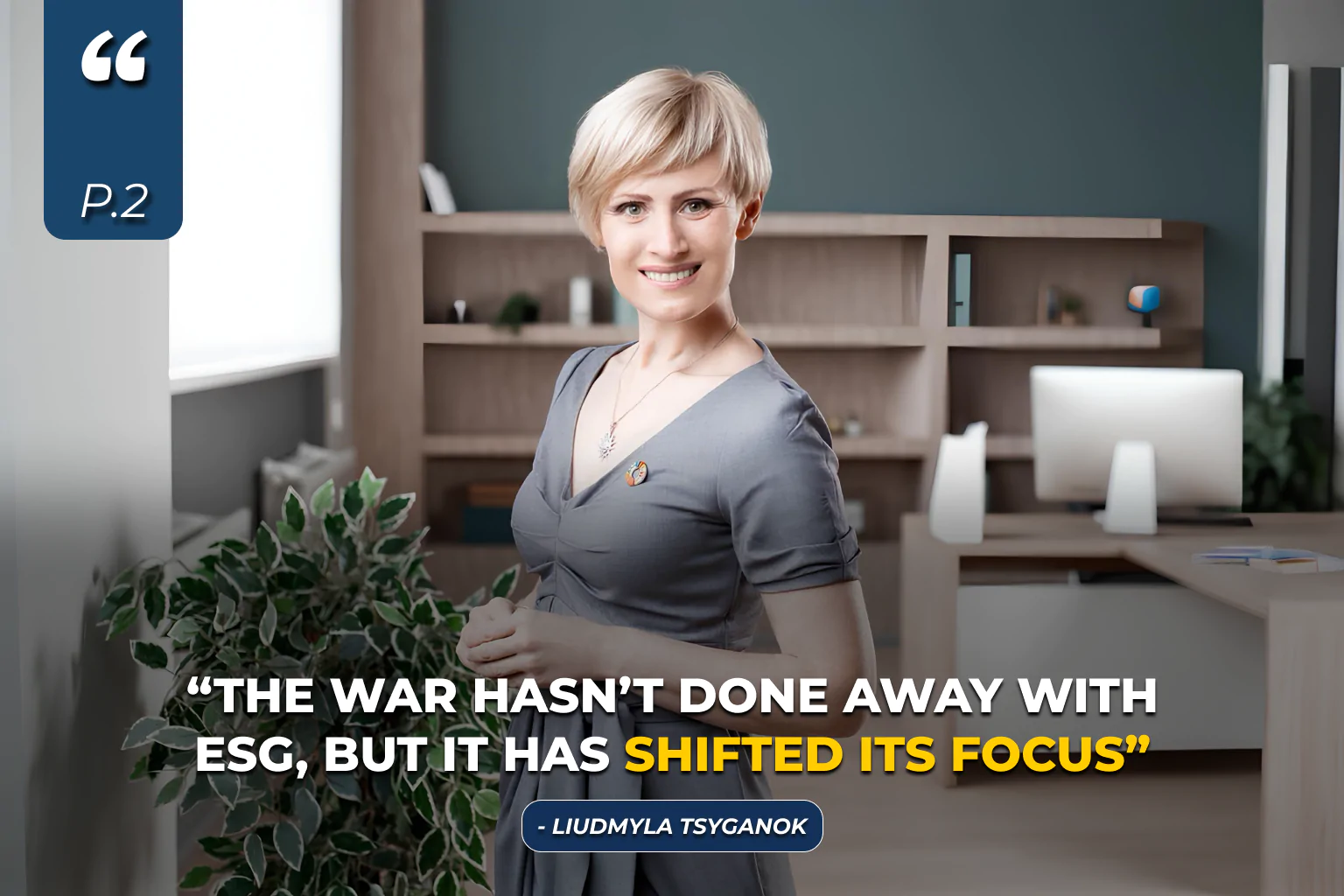
The war has not cancelled ESG, but it has changed its emphasis. For Ukraine today, sustainability means not only climate neutrality but business resilience. Can the company operate during power cuts? Does it have alternative energy sources? Can it retain staff?
For the dairy sector this is especially critical — the cold chain and production continuity cannot tolerate disruption. Energy efficiency, backup power, water security, local suppliers and risk planning are not additional ESG topics today — they are questions of operational survival.
Which standards or certifications are critical for the dairy sector today?
Food safety and quality systems remain the priority, but ESG adds a new layer. If a company works with European buyers or financing, it should orient toward ESRS logic, GRI as a transitional framework, TCFD/ISSB climate approaches, and sector metrics that help demonstrate materiality for food industry.
But a standard cannot be chosen just because everyone else uses it. First understand who the company is, where it sells, who finances it, what the bank or buyer requires — then choose the reporting framework.
How do you assess the situation with permits for companies producing compost from manure?
This is a very telling situation. On one hand, Ukraine declares a move toward circular economy and conversion of organic waste into resources. On the other hand, the practical path for business remains complex, expensive and over-regulated.
If a company wants to make compost from manure, it must navigate a complex documentation path. The problem is not that control is unnecessary — it is. The problem is that the procedure should be proportionate to the risk and should not kill decisions that are themselves ecologically beneficial.
Is there demand for sustainability from the end consumer in Ukraine?
Ukrainian consumers are currently far more sensitive to price, quality, safety and brand trust than to formal ESG. But that does not mean sustainability is absent from consumer choice — it manifests differently. People want an honest product, understandable origins, safe production, responsible animal treatment, quality packaging and locality.
After the war, this demand may become stronger, especially among urban consumers, in export, premium products and brands that work with trust. But it would be naive to bet that consumers will pay a premium for ESG alone. The stronger logic for business: ESG reduces risks, opens financing, improves management quality and strengthens the brand.
Are there data on European consumer loyalty to companies that promote ESG compliance?
The European consumer is more attentive to sustainability, but also increasingly critical of unsubstantiated claims. That is why the EU is tightening regulation of green claims, packaging, labelling, traceability and reporting. It is no longer enough to write ‘eco’, ‘natural’ or ‘responsible’. Evidence is required.
For Ukrainian dairy companies, this is an important signal: on the European market, sustainability can support loyalty, but only when confirmed by data, certification, transparent origins and clear communication.
Can decarbonisation be a competitive advantage for Ukrainian companies during wartime?
If we sell decarbonisation through emissions reduction, most companies simply will not hear that argument. But if we talk about reducing energy costs, decreasing dependence on external suppliers, cutting gas consumption and improving energy efficiency — that is a completely different conversation.
For most Ukrainian companies today, decarbonisation is interesting not because Europe wants it, but when it allows lower unit costs and makes business more resilient.
Where is the dairy sector losing the most money today?
As a rule, not where everyone looks. The biggest losses are often hidden in resources. In water that nobody measures. In heat that simply escapes into the air. In refrigeration equipment operating on outdated principles. In by-products that are treated as a problem when they could be a resource. In production data that exists in dozens of different Excel files and never adds up to a single picture.
A lot of what is called ESG transformation today is actually just quality business management.
What should Ukrainian dairy look like in five years?
The main competition of the future will not be between countries or even brands. It will be between resilient and non-resilient business models. Europe increasingly evaluates a company’s ability to operate under crisis conditions, manage resources, control risks, ensure traceability and fulfil obligations even in difficult circumstances.
And here is an interesting paradox: the war has given Ukrainian business an experience that most European companies simply do not have.
We learned to work during blackouts, rebuild logistics in days, operate under constant uncertainty, make decisions when no ready-made solutions exist. If this experience is combined with modern management of water, energy, waste, data and risks, Ukrainian dairy may not just adapt to new European rules — it could become one of the most resilient and competitive sectors in Europe.