
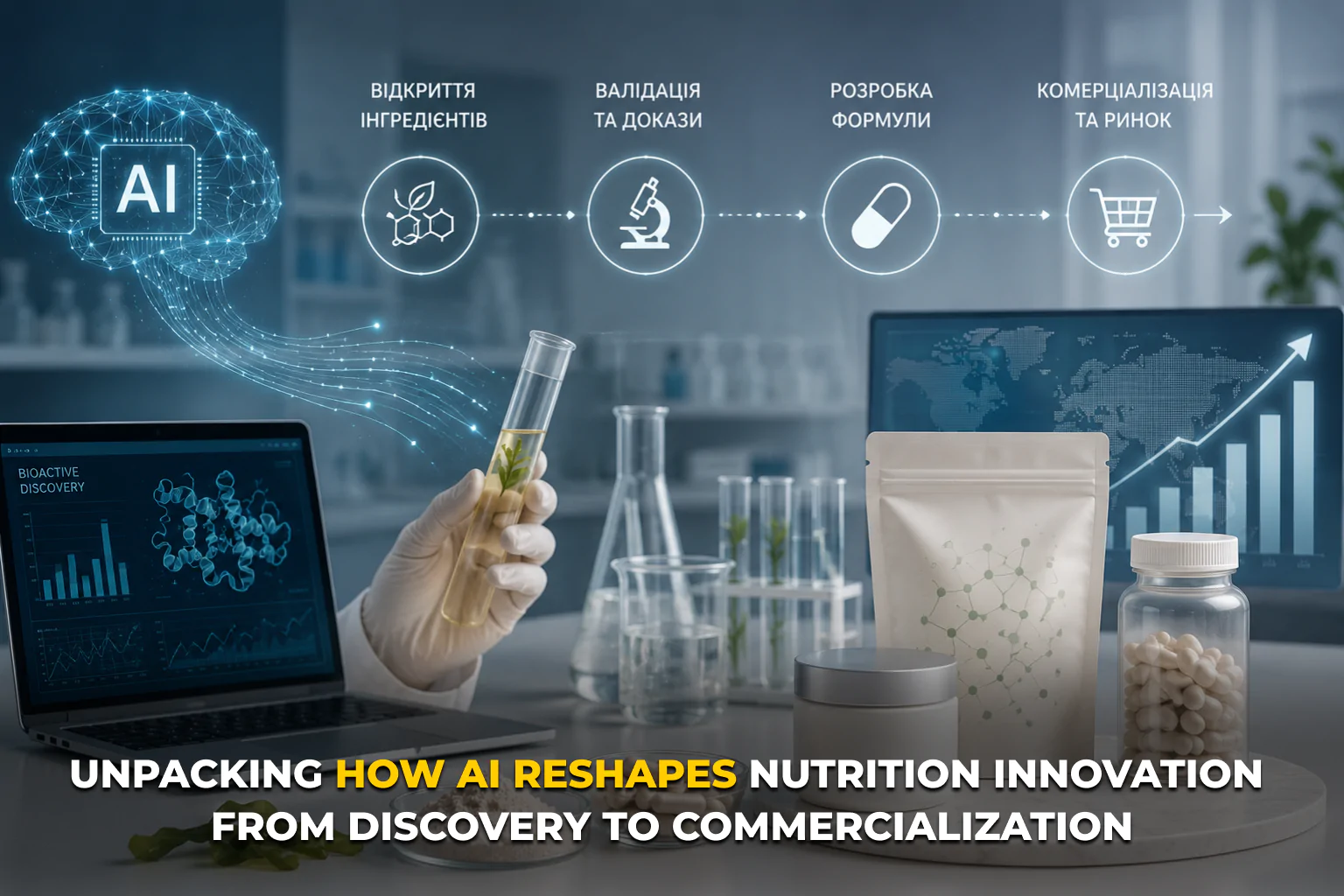
Artificial intelligence (AI) has made its mark on the nutrition industry, from consumers using it for personalised advice to businesses leveraging it in product development and marketing. Nutrition Insight explored its potential from ingredient discovery to commercialisation with experts from AI-powered nutraceutical suppliers Brightseed and Nuritas and marketing and AI-strategy specialists, Nutrition Insight reports.
Experts say AI compresses discovery timelines and shifts the challenge from generating ideas to choosing between them, while marketers warn it risks «industrialising sameness» unless brands structure evidence for machine readers.
From possibility to proof
«AI will fundamentally change how the nutrition industry moves from possibility to proof, ” says Lee Chae, Ph.D., co-founder and CEO of Brightseed, noting that manual search across fragmented data long made discovery slow and development risky.
Instead of treating discovery, validation, formulation and commercialisation as disconnected stages, she argues, AI can connect biological insight, evidence and decision-making earlier — letting companies evaluate more bioactive opportunities and understand mechanisms sooner.
Nora Khaldi, Ph.D., founder and CEO of Nuritas, agrees AI «helps teams compress timelines from years to months», adding that the Nuritas Magnifier platform has «identified more than eight million peptides» and enables a shift «from trial-and-error screening to more predictive, targeted discovery».
Where AI adds most value
Chae stresses AI’s value is not just speed — «speed without scientific rigour creates risk» — but improving the probability of success.
Khaldi sees the clearest value upstream, identifying bioactive candidates in natural sources: Nuritas uses AI to map peptide networks in food proteins and predict properties before lab work, weighing digestion survival, stability and absorption.
It used this to identify peptides for its rice-bran-derived PeptiSleep ingredient, with a pilot study showing 61% of participants fell asleep faster. Still, she notes, ingredients require validation (in vitro, in vivo and human clinicals): success will go to those who pair AI with deep scientific knowledge.
Product development, commercialisation and the sameness risk
BDB Global’s Jenny Mason says AI surfaces patterns faster, shifting discovery «from finding opportunities to deciding which ones are worth pursuing».
Independent expert Palak Uppal notes AI can cut literature review from weeks to «two hours», flag regulatory red flags (e.g., US FDA clearance), gather market insights and support scale-up. On marketing, Mason warns evidence «will need to be clear, well-structured and easy to interpret» — the clearest is what AI surfaces, the rest it «quietly passes over» — and that generative AI «is effectively industrialising the sameness that was already present», leaving brands to ask whether their content «would still be recognisable with the logo removed».
Source: Nutrition Insight