
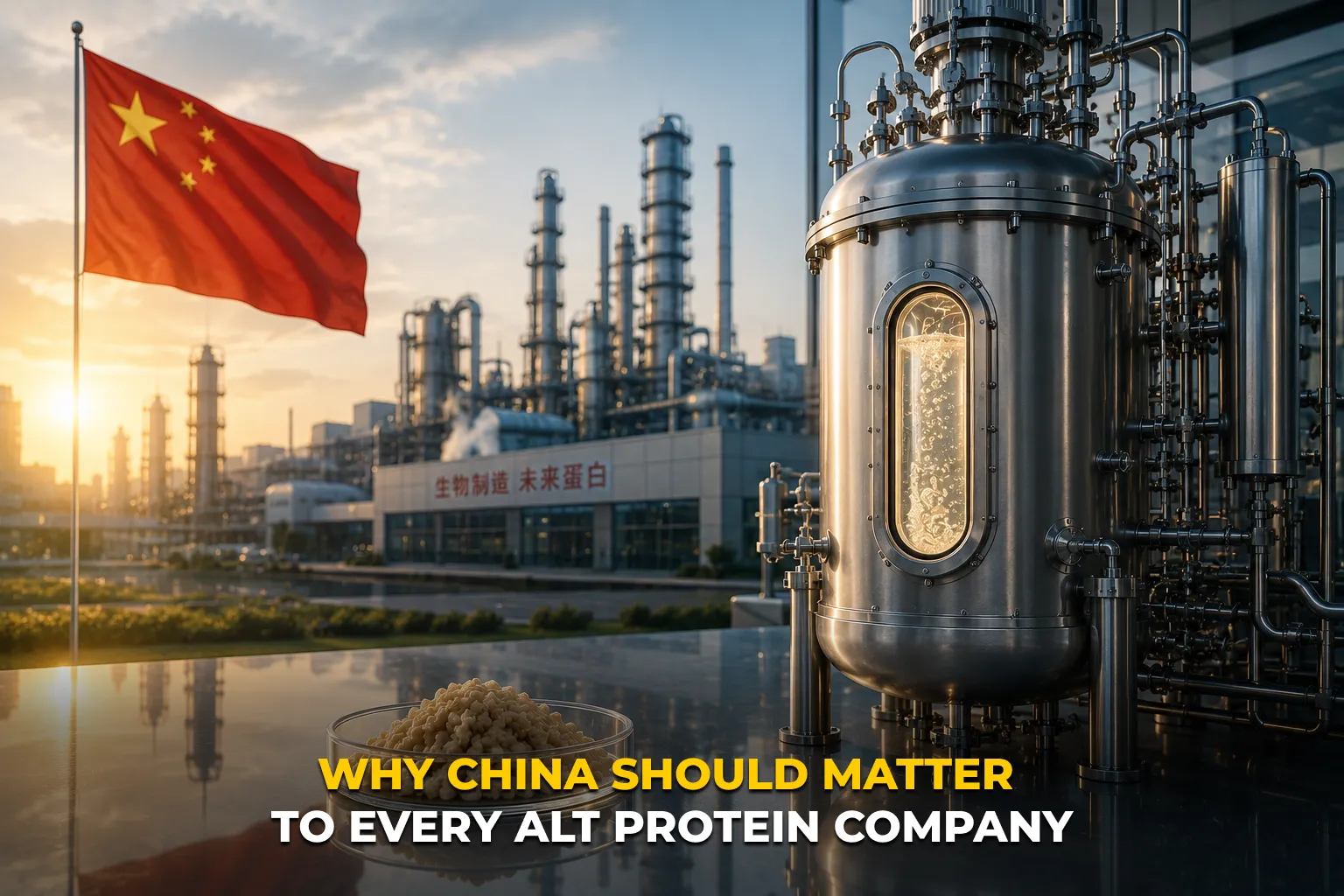
Despite geopolitical tensions, all alternative protein companies globally need to factor China into their production strategy to scale, compete and reduce costs.
China is emerging as a major manufacturing hub for alternative (alt) proteins, thanks to its fermentation expertise, government support and food-security focus — and it matters to dairy because alt proteins compete directly with traditional dairy products, DairyReporter reports.
Why it matters
To reach the mainstream, alt protein must achieve cost and taste parity with animal products, especially in price-sensitive Asia — forecast to consume the most protein globally by 2050.
Fermentation underpins many novel alt proteins (mycoprotein, microalgae-derived protein), and China already makes much of the world’s industrial and pharmaceutical fermentation output.
«China’s novel food transformation is underpinned by two main factors: economic and strategic», said biotech and geopolitics expert Dr Dirk van der Kley in a new report on China’s biomanufacturing boom via The Good Food Institute, adding that Beijing sees large-scale biomanufacturing as central to future manufacturing and food security.
With state support (locally «New Protein»), pharmaceutical plants could be repurposed for alt protein production.
Lower costs — and the risks
Building facilities in China is faster and cheaper, the report says: a rule of thumb is that a US$100 million US facility would cost around RMB100 million (~US$15 million) in China.
Active examples include US-based Calysta (gas-fermented microbial proteins, working with Bluestar-owned Adisseo) and Australia’s Nourish Ingredients (precision-fermented fats, working with CABIO Biotech).
Risks remain — President Trump’s tariffs and intellectual-property (IP) concerns — but van der Kley argues staying away is not sustainable long term, as China’s falling prices could spawn highly competitive startups.
«Engagement need not be an all-or-nothing decision», he said, urging companies to weigh a spectrum of approaches against the cost of non-engagement.
Source: DairyReporter