
Futures markets are signalling growing downside risk in dairy: a large New Zealand milk-price futures trade and a lower Fonterra forecast have strengthened the bearish case, but higher Global Dairy Trade (GDT) volumes, resilient Chinese demand and inventory-building have so far prevented the expected correction, CZ app reports, in an analysis by Czarnikow’s Dairy Monthly team.
Futures signal downside; physical market absorbs it
On 28 July a 5,000-lot Exchange for Swaps (EFS) trade was executed in SGX-NZX milk-price futures — large enough to prompt speculation it was linked to Fonterra, given its natural short position and recently cut forecast.
Fonterra has lowered its forecast to NZD 9.25/kgMS, more than NZD 0.25 below the traded market; a 25c move across 5,000 lots would be worth around NZD 7.5 million (~USD 4.4 million).
Yet the physical market resists: at the latest GDT event, whole-milk-powder (WMP) volumes were about 50% higher than the previous event, but prices held broadly unchanged, suggesting buyers are also building inventory resilience — including in China, where a weaker profile had been expected.
Freight, Brazil and timing
Freight is also complicating the bearish trade: rates from Latin America to Algeria, a key ONIL WMP route, reportedly rose by USD 750/container (~USD 30/tonne), while WMP has fallen only about USD 100/tonne.
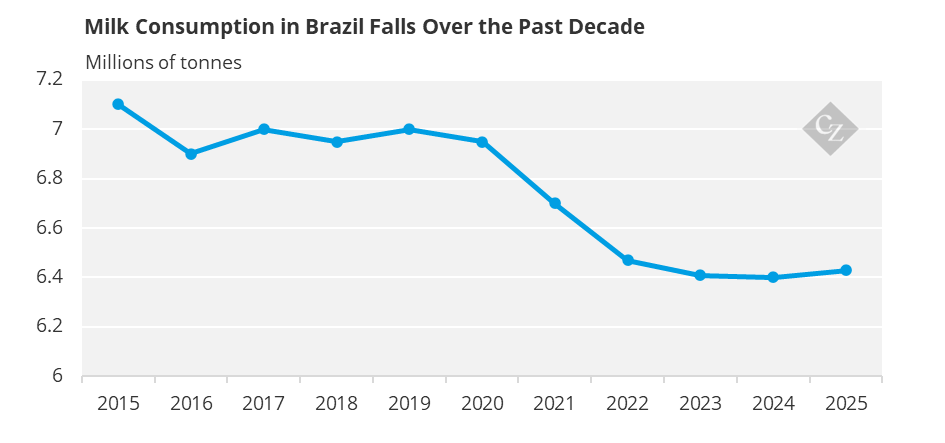
Brazil adds uncertainty: milk consumption is reportedly down about 10% while prices have risen around 90%, so El Niño production stress may not turn Brazil into the swing buyer the market expects — leaving global prices more exposed to any further softening in China.
Each bearish catalyst has met an offsetting force, so the central question is whether the market is truly overpriced or traders are simply early, underestimating physical demand’s resilience.