
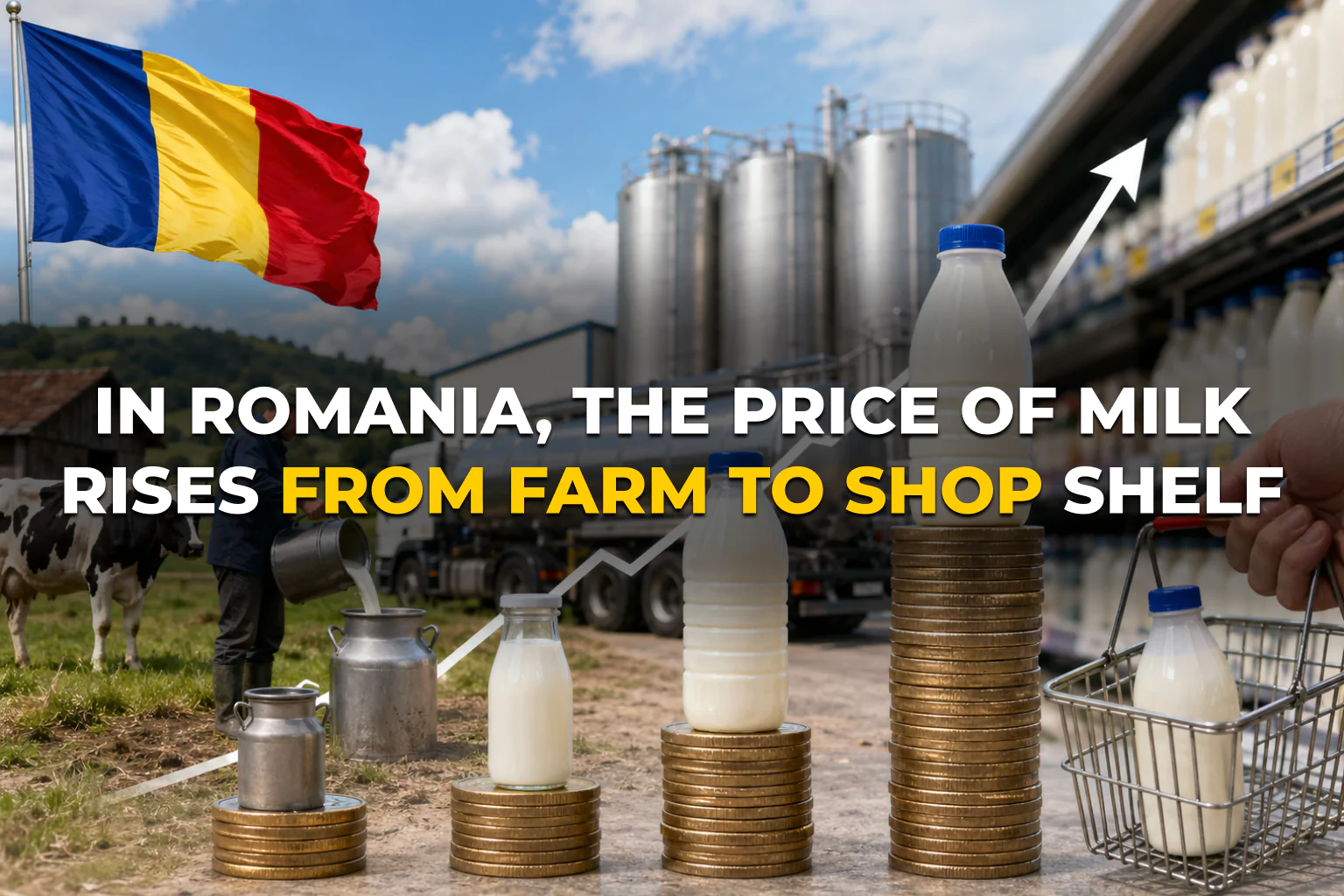
An imbalance is growing in Romania’s dairy supply chain: the retail price of milk can be several times higher than the price paid to producers. According to roaliment, farmers, processors and retailers offer different explanations for this situation.
Milk, one of the most widely consumed products in the country, shows a significant gap between farm-gate prices and retail prices. According to market participants, farmers often sell their raw milk at prices that sometimes do not even cover production costs, whilst the same product can cost several times as much on the shelves.
Price difference: from farm to shop
The figures highlight the scale of the imbalance. At the end of March, a litre of milk was selling for around 2.50 lei at the farm gate, but from 1 April the price fell to 1.70 lei under market pressure.
At the same time, milk is sold in shops for 8–10 lei per litre, depending on the brand and the degree of processing. As a result, the final price can be several times higher than the purchase price.
Despite a fall in the price of raw milk of almost 30%, consumers did not feel the impact. According to official figures, retail prices continued to rise, albeit at a slower pace in 2026.
Why is the price of milk rising?
Processors attribute the difference to the significant costs incurred between the farm and the shop shelf. These include logistics, transport, storage, laboratory testing, pasteurisation, packaging, energy, wages and delivery to retailers.
APRIL President Dorin Cojocaru notes: “From the moment the milk is collected from the farm until it leaves the factory, the cost of every litre at least doubles… On top of that come packaging, wages, transport, laboratory tests and, last but not least, taxes and other financial costs.”
At the same time, farmers believe that these factors do not account for such a significant difference in prices, pointing out that raw materials can account for up to 85% of the cost of dairy products.
Who benefits the most?
Market participants have differing views on the distribution of profits. Farmers accuse processors of putting pressure on purchase prices, whilst processors point to market mechanisms.
At the same time, considerable attention is paid to the role of retailers, where mark-ups can vary significantly depending on the brand and product positioning. The same type of milk can cost anywhere from around 3 to nearly 10 lei per litre.
The role of the state is particularly noteworthy. The tax burden includes VAT, labour taxes, excise duties and other levies. Overall, the share of taxes in the final price can reach around 46%, and for processed products — over 60%.
Pressure on farmers and the need for intervention
The situation is exacerbated by milk overproduction in Europe and the fallout from the economic crises, which are putting further downward pressure on purchase prices. As a result, farmers are warning that their livelihoods are at risk and are calling for government intervention.
The proposals include reviewing pricing mechanisms, tackling unfair practices and expanding financial support, including subsidies.
Romanian Minister of Agriculture Florin Barbu noted that the country’s economy is in a difficult state and requires measures to stimulate consumption, investment and the resumption of lending. He also proposed tax breaks for farmers, particularly on fuel.
Source: roaliment