
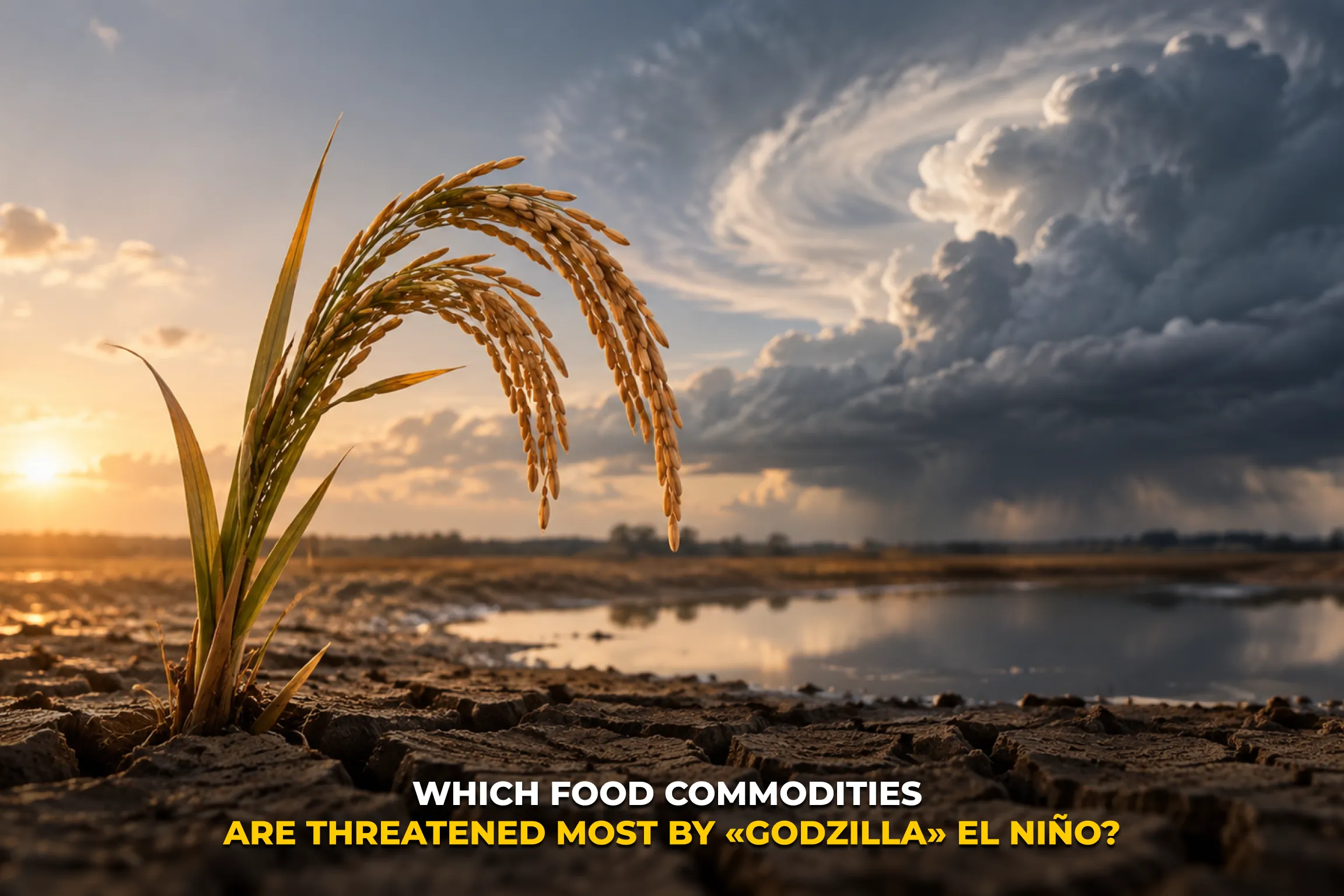
This El Niño could be the largest since the 19th century. But which food commodities does it threaten?
El Niño — the natural phenomenon that periodically warms the central and eastern equatorial Pacific and disrupts weather worldwide — takes its name from the Spanish for «little boy» or «Christ child». This year it is more monster than boy, FoodNavigator reports.
In June, the UN Food and Agriculture Organisation (FAO) and the World Food Programme (WFP) issued their first-ever joint appeal over what has been dubbed the «Godzilla El Niño», urging governments to fund a $220m effort to protect 9 million people from starvation risk across 22 of the world’s poorest countries.
To qualify as a «Super El Niño», sea-surface temperatures must rise 2°C or more; the 1998 event, which caused an estimated $5.7tn in global losses over five years, saw a 2.8°C rise. The September 2026 average ran 3°C above normal, with +4°C forecast by November.
El Niño is not new — first documented by Spanish surveyor Francisco de Alcocer in 1578 — but its magnitude is.
«The 2026–2027 El Niño looks to be significantly more severe than previous cycles,» says Oliver Carpenter, head of environmental analytics at climate-risk consultancy Risilience, which warns of a 14% fall in agricultural production worth $342.2bn over two years.
Climate change has likely «supercharged» the cycle, he adds, and unlike a localised event, a Super El Niño can disrupt many regions and food categories at once.
The risk is magnified by reliance on a few crops in concentrated areas: of more than 6,000 known crops, humanity draws about 60% of its calories from just three — rice, maize and wheat — with soy, sugar, oil palm, coffee and cocoa also major in global trade.
Rice most at risk
Rice is the world’s most consumed grain and the main calorie source for about half the global population — and one of the thirstiest crops, needing 3,000–5,000 litres of water per kilo, which leaves it especially exposed to rainfall disruption.
Risilience warns up to 26% of global rice output could be hit under worst-case forecasts, given production concentrated in India, Vietnam and Thailand.
India, Thailand, Vietnam and Pakistan supply nearly two-thirds of rice exports and have all seen erratic rain — long dry spells broken by destructive deluges. India, the top exporter, has been hit hardest. «India’s monsoon is approximately 13% below normal,» says Rob Weston, CEO of agri-intelligence platform CropGPT.
«In Andhra Pradesh and Telangana… August data shows rainfall down 46% and 63%, respectively. That could reduce crops by over 20%.»
Conversely, exporters such as the US and Italy (5.7% and 2.8% of the rice trade) may benefit: the FAO notes the southern US and western Europe often turn wetter during El Niño.
«Arkansas and Louisiana… typically experience wetter, cooler winters and springs during El Niño, which can provide favourable soil moisture going into planting,» says Eszter Somogyi, EMEA director at USA Rice.
But Somogyi warns against simplistic predictions: too-wet springs can delay planting and push acres into fallow, and «it would be easy to assume that regions associated with El Niño-related drought will automatically face supply disruptions. In reality, the picture is more nuanced.»
California (about 20% of US output) had 31% more rain than average in 2019 (a weak El Niño year) but 19% less in 2024 (a strong one). Jet streams, storm tracks and water-allocation decisions can amplify, weaken or override the El Niño signal, she notes.
Government policy matters for all traded crops.
«We’re analysing potential impacts on palm oil, coffee, soybeans and sugarcane… if major shortfalls occur, government intervention through export restrictions could remove significant volumes from global markets,» Carpenter says.
Sugar: simultaneous water stress
For sugarcane it has already happened: in May, India — then the world’s second-largest cane exporter — halted nearly all overseas shipments amid worsening drought. Cumulative rainfall in Karnataka, Andhra Pradesh and Tamil Nadu is down 28%, 30% and 32% this year.
«Simultaneous water stress across separate parts of the global sugar supply is going to have a severe impact,» says Weston — beet output is already down 22% in Germany and 15% in France, cane down 7% in India and 7.5% in Thailand, and with fertiliser shortages, prices are bound to rise.
In August, raw sugar posted its strongest monthly gain since October 2010, driven by weaker output in Europe, India and Brazil. El Niño brought drier weather to Asia and Europe but wetter, more favourable conditions to Brazil — though Brazil’s white-sugar output has been hampered by delayed harvests and by diverting cane to biofuel, more attractive since fuel prices soared after the Iran war.
Soy, wheat and maize may gain in places
El Niño is aiding some crops elsewhere: US soybean output is forecast up 2.3% year-on-year in 2026, China up 1.7% and Paraguay up 12.6%.
«Relatively strong conditions across the US are helping to offset losses elsewhere,» says Weston — though some US gain reflects more planted area than better yields, with heat and drought hitting Arkansas and Mississippi.
Annual crops like soy, wheat and maize may hold an edge over perennials as weather turns more erratic.
Perennials: cocoa, coffee, palm oil
«For perennial trees like cocoa, coffee and palm, you really cannot plant your way out in 90 days,» says independent agrifood advisor and cocoa expert Raphaël Felenbok, flagging cocoa and oil palm as especially exposed — over half of cocoa grown in Ghana and Ivory Coast, 80% of palm from Indonesia and Malaysia.»
«Procurement teams need upstream visibility, he warns: a book that looks diversified across eight suppliers can turn out to source from two countries under the same weather risk. Several firms were stung in 2024 by acting too slowly, only moving once cocoa passed $10,000 per tonne — «a little too late.»
What businesses should do: act now
«The best advice is to start reformulation… early,» Felenbok says — recipe changes, consumer testing and relabelling can take nine to 18 months.
Teams should know each product’s breaking point and the ingredient price at which margins fail, and have alternatives ready before reaching it. In other words, act now.
Source: FoodNavigator