
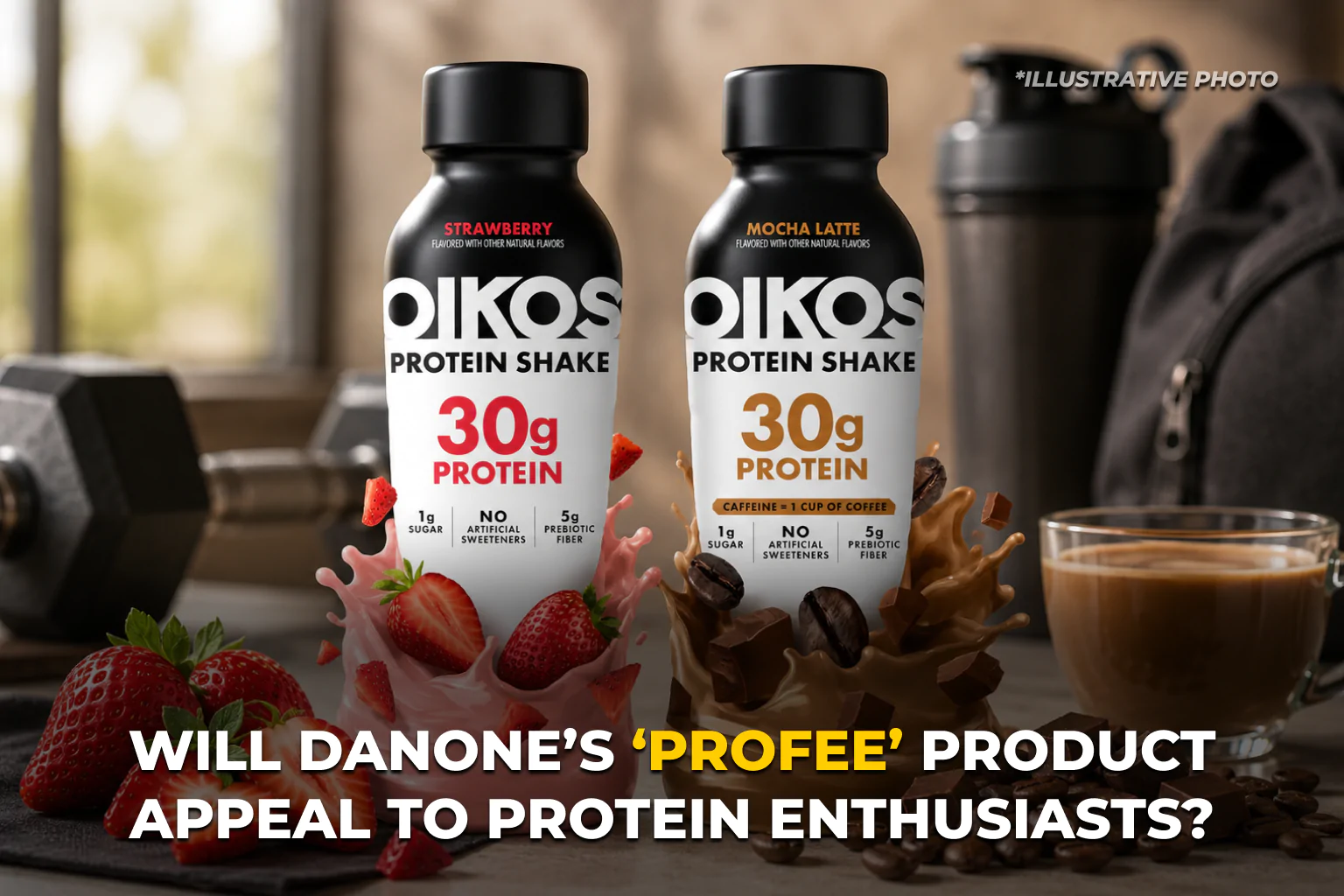
Danone is betting on one of the hottest trends in the food industry — profee, the combination of protein and coffee. As DairyReporter reports, the company has expanded its Oikos Protein Shakes line with two new flavours.
A year ago, Danone took its Oikos brand into the billion-dollar ready-to-drink (RTD) protein shakes segment to attract health-conscious consumers beyond the yogurt aisle.
The new Oikos Protein Shakes launched with a promise to ‘revolutionize the shake aisle’, but the start was steady rather than explosive. Danone had entered an already saturated market — dominated by Coca-Cola’s fairlife Core Power, PepsiCo’s Muscle Milk and BellRing’s Premier Protein.
However, with nearly half of Americans regularly consuming protein drinks, the range found its footing — and eventually scaled to major retailers such as Target, Walmart and Kroger, as well as becoming available in e-commerce. Oikos Protein Shakes are now ‘one of the fastest-growing RTD products’, Danone claims; and that has prompted a flavour expansion.
In May 2026, two trend-inspired additions joined the original line-up: Strawberry and Mocha Latte. Each shake is formulated to deliver a nutritional punch — 30g of complete protein, 5g of prebiotic fibre, plus vitamins A and D — but it is Danone’s nod to ‘profee’, the viral trend of adding protein to coffee, that makes this launch particularly interesting.
Why ‘profee’ is gaining traction
Mocha Latte delivers not just protein and fibre, but also 95mg of caffeine — the amount found in a cup of brewed coffee. With functional RTD drinks being one of the most buoyant categories in food and beverage today, this product checks many boxes — energy, satiety, muscle support and digestive health, plus convenience — making it a compelling addition to Oikos’ high-protein portfolio.
The range expansion also highlights Danone’s growing interest in convenient nutrition: this year the company acquired meal replacements major Huel and launched an Alpro Meal To Go range in Europe. Oikos Protein Shakes occupy a different niche and serve a broader purpose, but also sit in that shelf-stable, on-the-go space where convenience increasingly demands superior functionality.
Derek Neeley, Vice-President of Protein Shakes at Danone USA, said: “Based on what we’ve seen, protein shakes are evolving beyond the traditional post-workout occasion. Already, as the desire for high-protein options that support everyday wellness continues to grow, nearly half (46%) of Americans regularly consume protein drinks and shakes.”
“The category of shelf-stable protein shakes, powders and bars remains incredibly dynamic and is valued at over $16 billion, with particular strength in the ready-to-drink segment,” he added. “We’ve seen strong, double-digit category sales growth within the Strawberry and Coffee flavours.”
The introduction of a new RTD product, timed with the take-off of a fresh protein trend, could be the ingredient that galvanizes Danone’s protein shakes portfolio.
It is also a sign of category blurring with the chilled RTD coffee space. There, ‘profee’ is new in name only: protein-fortified drinks have been appearing consistently in recent years, with brands racing to solve formulation and taste challenges to balance quality and functionality. Competition is so fierce that RTD chilled coffee category leader Starbucks is now turning to fashion and fitness tie-ups to promote its new Coffee & Protein beverage.
RTD protein’s growth trajectory
— Convenience-led demand: expansion into ambient products reflects strong consumer appetite for convenient protein options.
— RTD dominates: ready-to-drink accounts for over 50% of category sales.
— Market size: $9.7bn.
— Rapid growth: the segment has delivered a 17% CAGR over the past three years.
What Danone’s protein shake push is delivering
As for Danone, last year’s expansion into protein shakes has enabled the company to recruit new consumers and support Oikos’ brand equity.
“By moving into the protein shake aisle, we’ve successfully connected with a broader audience focused on convenient, on-the-go nutrition,” Neeley said. “We’ve also learned that these consumers, who may not always be traditional yogurt buyers, are driven by their desire for easy, on-the-go products that deliver on both taste and nutrition to ultimately help them achieve their protein goals — and we have seen Oikos Protein Shakes support incremental purchase for Oikos yogurt.”
“These consumers include everyone from busy professionals to parents, as well as those with specific wellness goals, such as the growing number of GLP-1 users who are looking for nutrient-dense, high-protein options that are easy to add to their day and offer other relevant benefits, such as digestive health support,” Neeley explained.
What these shoppers want next is variety, he added — whether through flavour or functionality, or both.
“Today’s consumers expect more from a shake beyond high-quality protein. That’s why Oikos Protein Shakes offer added functional benefits — including 5g of prebiotic fibre to support digestive health — along with a variety of flavours, creamy texture with no artificial flavours or sweeteners.”
With nearly one in eight US adults now taking GLP-1 medications, that is an increasingly important consumer cohort — and one that boosts demand for protein, fibre and low-sugar solutions, Neeley said.
So-called flavour fatigue — the way flavour receptors are affected as a side-effect of the medication, leading to reduced taste sensitivity and lower appetite — is also shaping product expectations.
“Ultimately, the trifecta of taste, nutrition and convenience is necessary to convert a trial purchase into a daily habit,” Neeley said. “Consumers will not form a routine around a product they don’t genuinely enjoy, which is why our focus is on providing great-tasting protein shakes that deliver functional benefits without compromise.”
And so, Danone has leaned into ‘profee’ as part of its flavour and functionality expansion in the ambient shakes category. Would shoppers buy into the emerging, category-blurring format? It is a bet that will play out as coffee and protein continue to converge.
Source: DairyReporter